
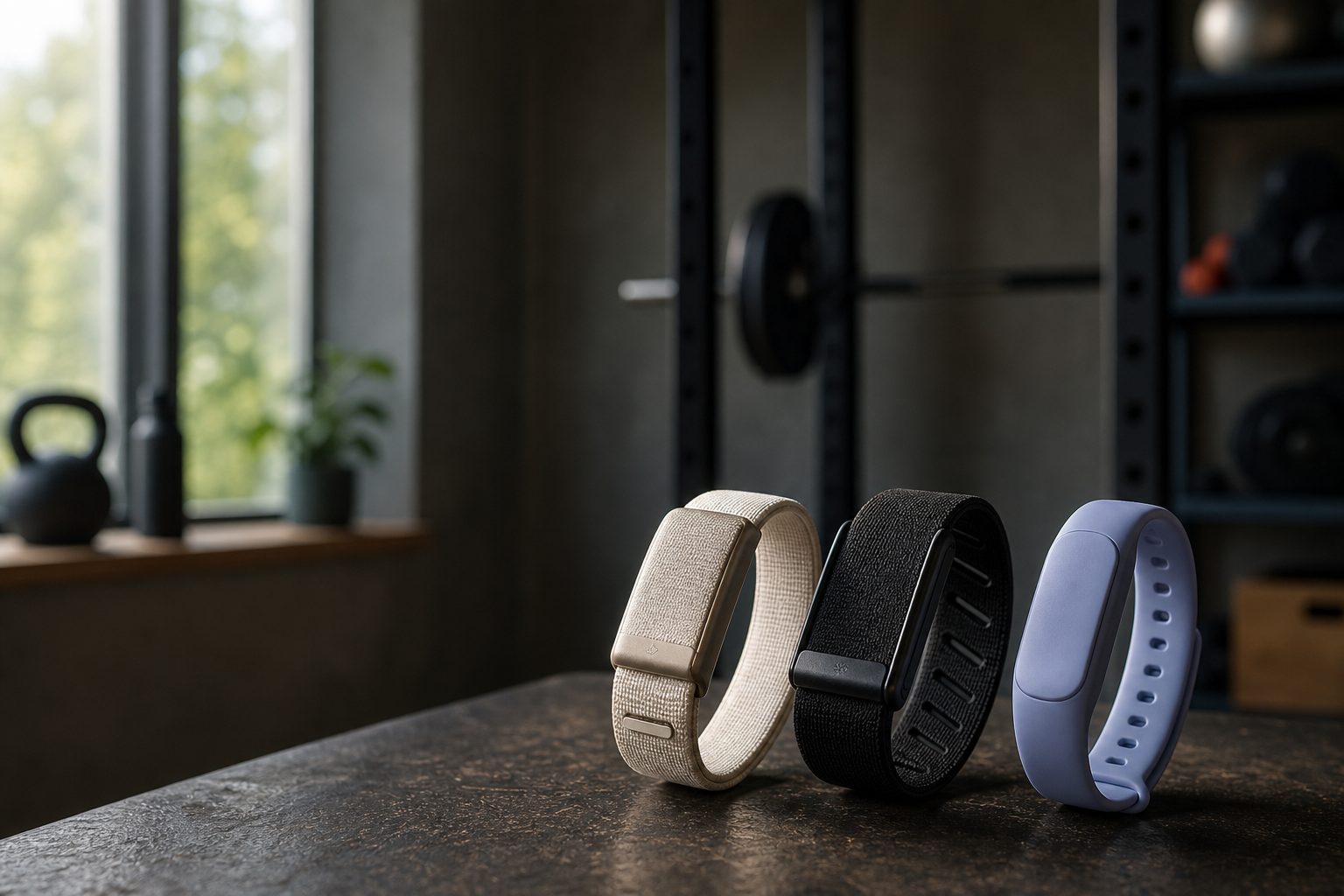
Garmin CIRQA, WHOOP 5.0 and Google Fitbit Air all leave the watch face behind, but their ideas of what should replace it are rather different.
Garmin CIRQA vs WHOOP 5.0 vs Fitbit Air: Which Screen-Free Tracker Wins?
Three discreet fitness bands, three very different ownership models, and one sensible question before you strap anything to your wrist: which tracker gives you the useful training and sleep detail without turning your monthly bank statement into another health metric?
 By James Oduya · Staff Writer & Home Gym Columnist · Updated August 01, 2026
1. The short version: three bands, three philosophies
Screen-free fitness tracking had become a properly interesting category by August 2026. Not because anyone suddenly stopped liking a bright smartwatch display, but because plenty of gym-goers had worked out that they did not actually need a tiny rectangle buzzing at them whilst lifting, sleeping, eating dinner or trying to read a book. They wanted the data. They did not necessarily want the theatre.
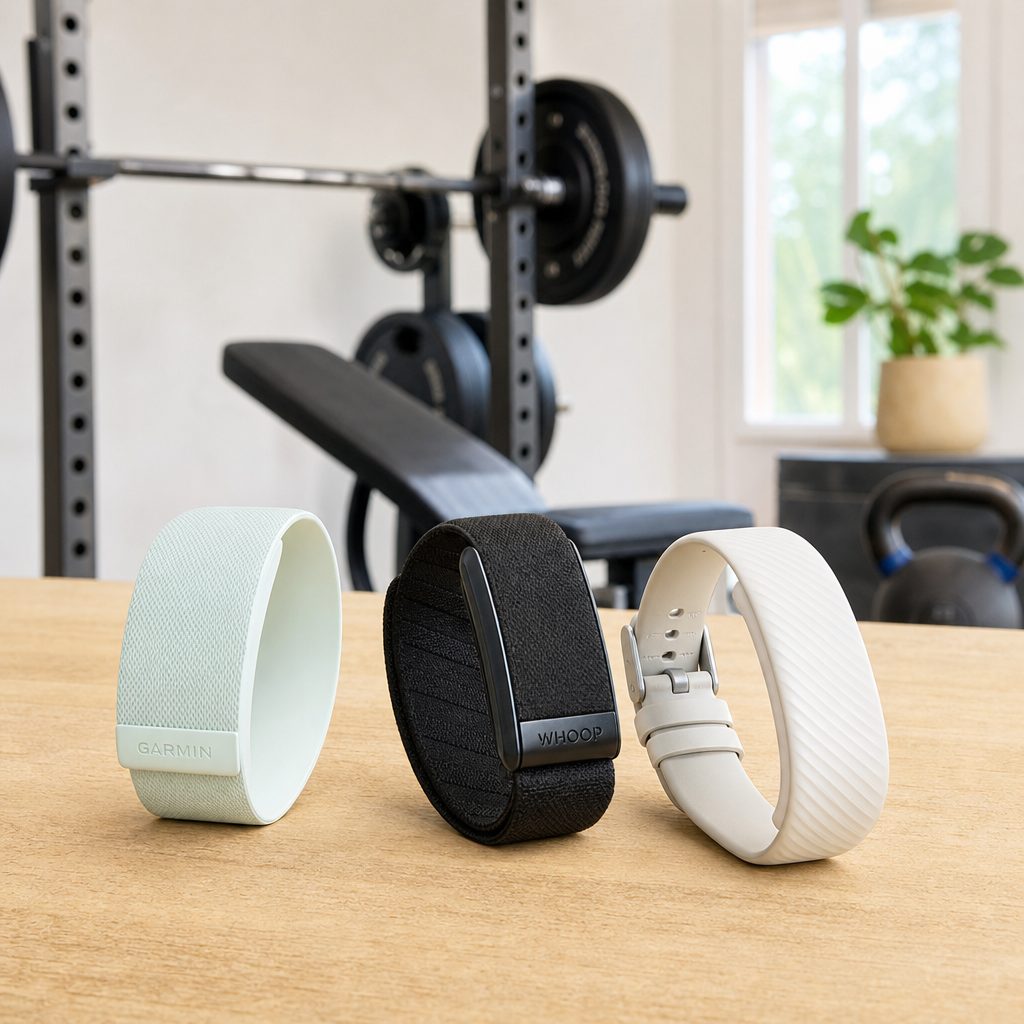
A screenless tracker should disappear into daily life; the quoted weight differences here are not trivial when the band is worn through sleep, training and work.
Garmin CIRQA, WHOOP 5.0 and Google Fitbit Air all addressed that desire, yet they did it from noticeably different directions. Garmin CIRQA was the practical sports-watch brand's first screenless smart band: a light wearable that fed into Garmin Connect, tracked continuous wellness and training metrics, and made its principal case with the words many buyers rather like to hear: no required subscription. WHOOP 5.0 remained the data-rich membership proposition. The hardware was supplied through the membership, and the experience revolved around recovery, strain, sleep, stress and longer-term health interpretation. Fitbit Air arrived as Google's first screen-free Fitbit tracker, priced aggressively and deliberately positioned as a quiet alternative to the traditional display-led band.
That means there was no single clean winner before you had established what sort of wearer you were. A person who already lived in Garmin Connect and wanted training readiness without another ongoing bill should look very closely at CIRQA. Someone who wanted the deepest explicitly defined activity catalogue, body-location flexibility and a membership-led coaching approach should put WHOOP 5.0 at the top of the list. Someone who mainly wanted the least expensive, extremely light entry into screenless tracking had a compelling starting point in Fitbit Air.
The awkward bit, because there is always one, was that "screen-free" does not make these interchangeable. No display means your phone app becomes more important, not less. It also means the accuracy and interpretation of the metrics matter enormously. There is no clever watch face to distract you if the fundamental experience does not fit your routine. A beautiful woven strap is lovely. A useful answer to "should I push through this hard session?" is lovelier.
One naming point worth settling before we go any further: Fitbit Air was the screen-free wearable. Fitbit Aria Air was a smart scale, which is a very different thing to accidentally put in your basket unless you enjoy weighing your wrist.
2. Garmin CIRQA vs WHOOP 5.0 vs Google Fitbit Air: at-a-glance numbers
Before we get into the practical bits, here are the hard figures that most clearly separate these trackers. They are all display-free, all Bluetooth-connected, and all designed for continuous use. Beyond that, the numbers tell a useful story. WHOOP led on quoted battery endurance and supported activities. CIRQA offered the strongest stated water-resistance figure and a very low device weight. Fitbit Air was the featherweight overall once its band was fitted.
| Feature | Garmin CIRQA | WHOOP 5.0 | Google Fitbit Air |
|---|---|---|---|
| Release date | 24 July 2026 | 8 May 2025 | 26 May 2026 |
| Screen | None | None | None |
| Quoted battery life | Up to 10 days | 14 days | Up to 7 days |
| Weight | 14.8g module; 15–20g with strap | 26.5g | 5.2g housing; 12g with band |
| Water resistance | 5ATM / 50 metres | IP68 / down to 10 metres | 5 ATM (50 meters) |
| Supported or auto-detected activities | 80+ | 145+ | — |
| Subscription | Not required for core metrics | Required membership | — |
| Phone compatibility | Garmin Connect with Bluetooth connection | Bluetooth | Android and iOS |
Do not read the dashes in a comparison table as a criticism in themselves. A tracker is more than a specification sheet, and the Fitbit Air's appeal was plainly its uncomplicated, affordable and very light hardware. But for a buyer choosing specifically on sleep depth, recovery analysis and automated gym logging, Garmin and WHOOP supplied more defined feature claims to work with. That is important. You should buy on what the tracker demonstrably does for your routine, not on the vague hope that it will turn into a different product after a few app updates and a motivational Tuesday.
3. Two-year cost: the subscription question gets real quickly
This was the section where the three-way comparison became less philosophical and more like a mildly unpleasant conversation with a calculator. Garmin CIRQA launched at $199.99 and £179. Google Fitbit Air cost $99.99 or £84.99. WHOOP 5.0 had no conventional standalone hardware price in this comparison because the tracker came with membership: $199 per year for WHOOP One, $239 per year for WHOOP Peak, or $359 per year for WHOOP Life.
For a fair two-year comparison in dollars, Garmin's core experience cost $199.99. Garmin Connect+ was optional at $69.99 a year, taking a two-year CIRQA plus Connect+ total to $339.97. Fitbit Air's two-year hardware cost remained $99.99. WHOOP One reached $398 over two years, WHOOP Peak reached $478, and WHOOP Life reached $718. Those are not small gaps, particularly when the tracker category is supposed to be about reducing friction rather than introducing a subscription you need to remember every year.
Google Fitbit Air
Hardware cost over two years: $99.99. The lowest-cost route into this particular screen-free trio.
Garmin CIRQA
Core metrics carry no required subscription. Two years with optional Connect+ totals $339.97.
WHOOP 5.0 One
Two-year membership total: $398, including the required membership-based hardware model.
WHOOP 5.0 Peak
Two-year membership total: $478 for the longevity and health-management tier.
WHOOP 5.0 Life
Two-year membership total: $718 for advanced health and heart monitoring.
WHOOP's defenders will reasonably say that this is not a hardware purchase in the usual sense. You are paying for the ongoing platform, support, feature updates and the analysis layer, not simply a fabric band and a sensor. That is true. It also does not make the £-and-$shaped hole in your budget any smaller. The membership is either the product's greatest strength or its deal-breaker, depending on whether you genuinely use the insights consistently.
Garmin's model was refreshingly straightforward. Buy CIRQA, use the core metrics inside Garmin Connect, and decide separately whether Connect+ adds enough for you at $69.99 per year. The important word there is decide. The daily information was not held behind a compulsory tollbooth. That ownership freedom is worth a lot to people who have already acquired enough subscriptions to music, television, storage, recipes, meditation and, somehow, a doorbell.
Fitbit Air was the blunt financial winner. At $99.99, it cost less than one year of WHOOP One and roughly half Garmin CIRQA's US launch price. The sensible caveat is that a lower up-front price does not automatically make it the strongest value for every athlete. If you need detailed recovery and clearly stated training tools, the cheapest device may not be the cheapest way to obtain the outcome you wanted. But if your desired outcome is simply a discreet screen-free wearable at the lowest purchase cost, Fitbit Air had a formidable argument.
The useful way to compare subscriptions
Do not ask whether a subscription is "bad". Ask whether you would still willingly pay for it in month 15, when the novelty has worn off and your training is ordinary rather than Instagram-worthy. If the answer is no, Garmin's subscription-free core experience has a clear advantage.
4. Screen-free design, comfort and everyday wear
All three trackers got the central brief right: there was no screen to swipe, no notification parade, and no watch face clamouring for a second of your attention. That was not a missing feature. It was the feature. If you wanted a device that could sit quietly on your body, collect information and leave you to get on with your day, each of these bands made more sense than a smartwatch trying to become a miniature phone.
Fitbit Air had the strongest pure minimalism claim. Its housing weighed 5.2g and the complete tracker with its band weighed 12g. Those figures matter most overnight. A difference of several grams may sound like the kind of thing only a spreadsheet would care about, but a wearable is not a kettlebell. You wear it for hours at a time, perhaps continuously. Less bulk can mean fewer occasions when you notice it, fidget with it or decide that tonight, actually, the bedside table can do the tracking.
Garmin CIRQA's device-only weight was 14.8g, with a worn weight of 15g to 20g depending on size and strap configuration. Its 24mm strap and available S/M and L/XL wrist sizes made it more substantial than Fitbit Air, although still clearly light in the broad world of fitness wearables. CIRQA also had a single side button. You could use it to manually start a favourite activity specified in Garmin Connect, which was a sensible halfway house between entirely passive tracking and the faff of using a screen.
WHOOP 5.0 weighed 26.5g and measured 34.7mm by 24mm by 10.6mm. It was the heaviest of the three, but it also offered the most flexible wearing ecosystem: wrist, torso, waist or calf through WHOOP Body apparel. That is more significant than it first appears. Some people dislike wrist wear in the gym, especially for kettlebell work, front-rack positions, barbell cleans or anything that puts a wrist wrap, strap or lifting glove in the same physical postcode as the tracker. WHOOP's alternative locations could make it the most practical option for those users.
No display on any of the three
CIRQA, WHOOP 5.0 and Fitbit Air all prioritised passive, app-led tracking rather than notifications, widgets or a visible watch face.
Garmin CIRQA retained one physical control
The side button could start a favourite activity chosen in Garmin Connect. It gave gym users a quick intentional action without turning the band into a miniature touchscreen.
WHOOP 5.0 was the placement specialist
WHOOP Body apparel supported wear on the torso, waist and calf as well as the wrist, making the system unusually adaptable around certain sports and strength sessions.
Google Fitbit Air was the lightest worn option
At 12g including the band, Fitbit Air made the clearest case for people who wanted the least noticeable tracker in this comparison.
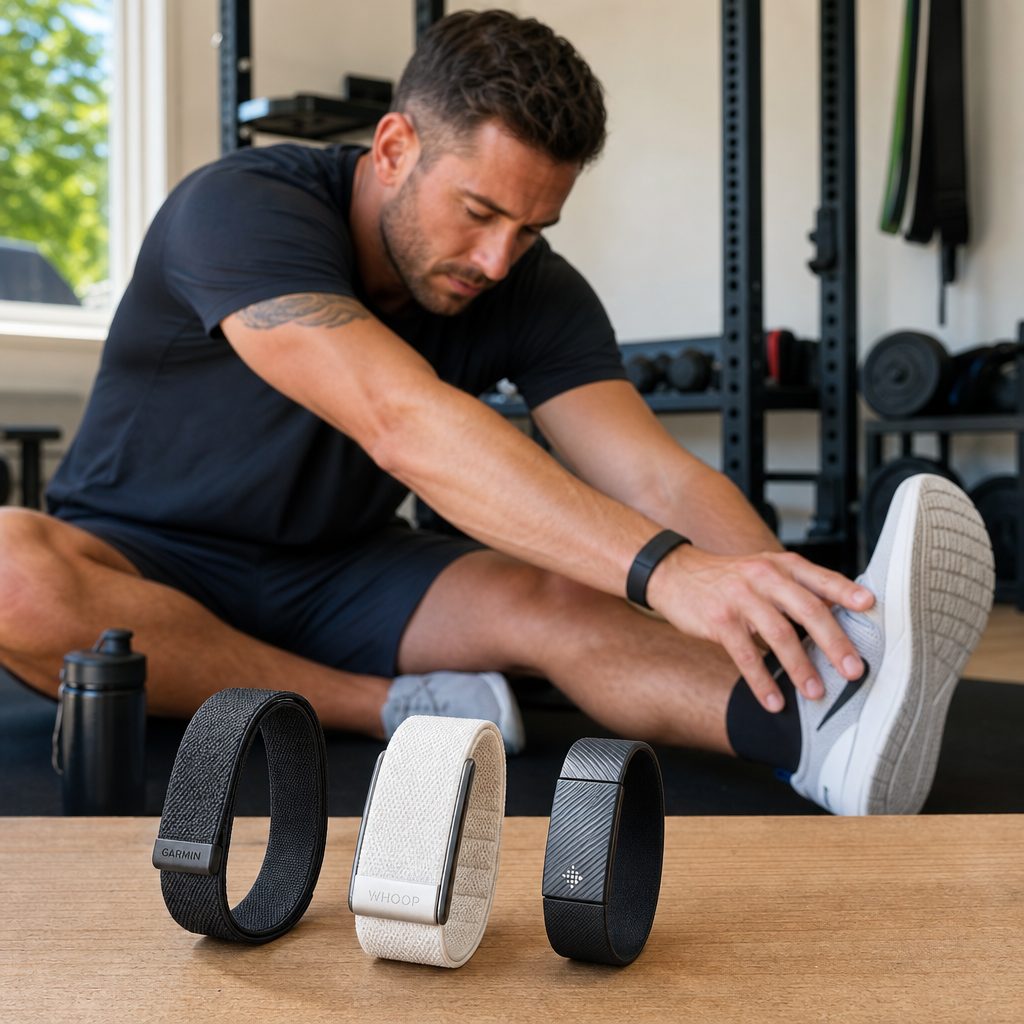
The absence of a display is the point here: each band shifts attention away from the wrist and back towards the training session, sleep or ordinary day.
There was no universal comfort victor because body shape, band tension, training style and sleep habits all matter. But there were clear routes. Fitbit Air was the choice for minimal worn mass. Garmin CIRQA was the sensible middle ground for people who wanted a traditional wrist band with a small amount of direct control. WHOOP was the choice for a wearer who valued location options enough to accept the 26.5g figure.
5. Battery, charging and water resistance
Screenless trackers ought to be good at battery life. With no always-on colour display draining the battery, the basic expectation is that you should spend more time wearing the device than charging it. On quoted figures, WHOOP 5.0 led the group at 14 days, Garmin CIRQA followed with up to 10 days, and Fitbit Air offered up to seven days. None of those numbers were embarrassing. WHOOP simply asked you to think about charging least often.
WHOOP 5.0 used a redesigned processor claimed to deliver 10 times more power efficiency, alongside sensors that captured data 26 times per second. Its basic charger had a stated 152-minute charging time, while the PowerPack took 110 minutes. The headline battery claim was 14 days, and the Wireless PowerPack enabled extended use with monthly charging. For a continuous tracker, that is a very attractive practical arrangement. Sleep tracking is only useful if you actually wear the thing to bed, and battery anxiety has an irritating habit of creating gaps precisely when recovery data would have been most useful.
Garmin CIRQA used a proprietary Garmin charging port with USB-C on the other end. Ten days was still excellent for a compact health band. In the real rhythm of ownership, it meant a quick, deliberate charge roughly once a week and a half rather than constant top-ups. That is enough to make charging an occasional chore rather than an evening ritual. Garmin also offered 5ATM water resistance, stated as 50 metres, which gave CIRQA the strongest quoted water resistance specification of the three.
WHOOP's IP68 rating covered water down to 10 metres. For sweat, showering and ordinary wet-weather life, that was a useful level of protection. Yet the numbers make the distinction clear: CIRQA had the more robust stated rating for buyers whose use involved regular pool time or who simply wanted the higher water-resistance figure on paper. Fitbit Air's supplied details centred on its weight, size, battery claim, price and cross-platform compatibility rather than a water-resistance rating, so it did not take this category.
Battery life should also be judged by what it enables. A seven-day device can be perfectly manageable if you have a stable charging habit. A 14-day device is more forgiving if you travel often, sleep away from home, train irregularly or are simply the kind of person who notices their charger only after it has gone missing under a pile of laundry. There is no moral failing in being that person. There is, however, a good chance WHOOP's endurance will suit you.
6. Sleep, recovery and daily health depth
This was where Garmin CIRQA and WHOOP 5.0 most clearly earned their higher cost. Both were built around a bigger idea than recording a workout. They aimed to gather a continuous view of how your body was coping: sleep, heart rate, heart-rate variability, temperature-related signals, oxygen saturation, stress and the relationship between recovery and training load. That was the real reason to choose a screen-free tracker. You were not checking it during the session; you were using the accumulated picture later to make better decisions.
CIRQA monitored continuous heart rate, blood oxygen saturation, respiration rate, heart-rate variability, skin temperature and stress levels. It also supplied Garmin's Training Readiness score, which combined sleep quality, HRV status, recovery time and acute load. For a gym regular, that was immediately intelligible. You did not need a degree in sports science to understand the broad message: if your sleep was poor, recovery time remained elevated, HRV status was not where you wanted it and acute load was high, perhaps today was not the day to transform yourself into a human deadlift montage.
The appeal of Garmin's approach was its connection to an established training vocabulary. Acute load and recovery time gave the data an exercise context, whilst Training Readiness rolled several inputs into one daily score. Some athletes will want to inspect every metric. Others will appreciate one clean suggestion before they decide whether to do intervals, take a long walk or just complete the programme without trying to set a personal best in every accessory lift.
WHOOP 5.0 continuously monitored sleep, strain, recovery, stress, heart rate, blood oxygen, skin temperature and VO2 Max. It also introduced Healthspan Tracking through WHOOP Age and Pace of Aging. The platform's framing was broader than a simple "trained hard, recovered poorly" loop. It connected fitness performance to longer-term health management, particularly at the Peak tier, and included 145-plus supported activities. WHOOP Life added advanced health and heart monitoring, whilst ECG capability was exclusive to the separate WHOOP MG rather than standard WHOOP 5.0.
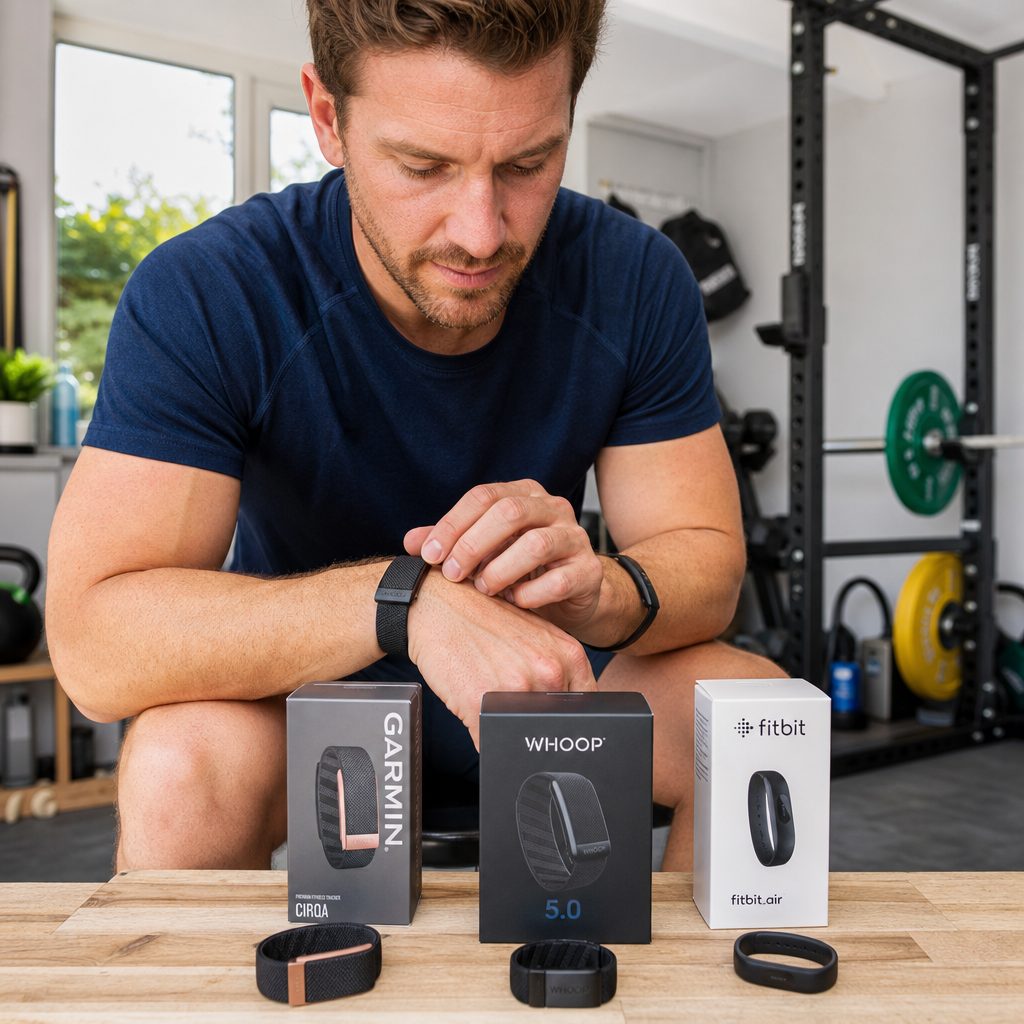
Recovery data only becomes useful when it changes a decision: Garmin's Training Readiness and WHOOP's recovery-led approach both try to turn overnight signals into a clearer training day.
That WHOOP distinction deserves a little care. WHOOP 5.0 and WHOOP MG were not the same product. It was easy to see a headline about ECG and assume every WHOOP 5.0 strap had it. It did not. The standard 5.0's value was its continuous fitness and health data, activity support, Healthspan tracking and membership-led interpretation. Buyers interested specifically in medical-grade ECG capability needed to understand that it belonged to WHOOP MG.
Fitbit Air's strongest known proposition in this comparison was not a published set of sleep and recovery features to match either Garmin or WHOOP. It was the lower-cost, lighter screen-free route. That is not a dismissal; it is a reminder to buy honestly. If deep sleep interpretation, HRV-informed recovery and explicitly named readiness tools are your priorities, CIRQA and WHOOP were the two products whose stated toolsets addressed them directly. If lightweight, simple screen-free tracking is the priority, Fitbit Air's low mass and low price remained its own very persuasive sort of depth.
Garmin CIRQA strengths
- Training Readiness combined sleep quality, HRV status, recovery time and acute load.
- Continuous heart rate, SpO2, respiration, HRV, skin temperature and stress tracking were all part of the core proposition.
- Useful core metrics did not require a subscription.
Garmin CIRQA limitations
- Its Gen 4 optical sensor was one generation behind Garmin's Gen 5 platform.
- The tracker depended on a paired phone for connected GPS.
- Its activity support total was lower than WHOOP's 145-plus list.
For many people, the best recovery system is not the one that exposes the most numbers. It is the one you can understand at 7am, act on at 6pm and still trust after three months. Garmin was arguably the clearer choice for people already comfortable with Garmin's language of load, recovery and readiness. WHOOP was better suited to someone who wanted a fuller subscription-led health platform and was happy to make the app a genuine part of their routine.
7. Gym tracking and auto-detection: the category's key battle
For Total Gym Gear readers, this was the pivotal category. A screen-free tracker can deliver lovely sleep charts, but if it cannot make sense of regular lifting, conditioning, circuits, classes and spontaneous gym sessions, it becomes a wellness band that occasionally happens to see a squat rack. Garmin CIRQA and WHOOP 5.0 both gave much stronger explicit answers than Fitbit Air in the supplied product details.
Garmin CIRQA supported more than 80 auto-detected sport types. Its single button could manually start a favourite activity selected in Garmin Connect. That combination had a practical logic. Auto-detection handled the everyday occasions when you did not plan ahead, whilst the button gave you a way to tell the band, "yes, this is intentionally a workout," without taking out your phone or navigating a touchscreen mid-session. It was unobtrusive in exactly the way a gym band ought to be.
WHOOP 5.0 supported more than 145 activities, the broadest stated list here. It continuously monitored strain and recovery across those activities, and its wearable placement options could be particularly useful for strength training. If wrist placement was awkward for your preferred work, WHOOP Body apparel opened up torso, waist and calf wear. That is not just a lifestyle accessory detail. It can be the difference between wearing the tracker during a session and leaving it in a locker because it gets in the way of a lifting strap or presses against a bar.
| Gym and training consideration | Garmin CIRQA | WHOOP 5.0 | Google Fitbit Air |
|---|---|---|---|
| Stated activity coverage | 80+ auto-detected sport types | 145+ supported activities | — |
| Manual workout control | Single button starts a selected favourite activity | Yes | — |
| Recovery tool for training decisions | Training Readiness | Recovery and strain monitoring | — |
| GPS arrangement | Connected GPS via paired phone | None | — |
| Alternative body locations | Optional bicep strap at $49.99 / £49.99 | Wrist, torso, waist or calf with WHOOP Body apparel | — |
| Heart-rate broadcasting | ANT+ | Yes | — |
Garmin's optional bicep strap cost $49.99 or £49.99. That mattered for gym users who preferred upper-arm placement and for anyone building a more deliberate training setup around CIRQA. Garmin could also broadcast heart rate over ANT+, which was a genuinely useful feature for people pairing the band with compatible gym equipment or other training devices. It made CIRQA feel less like a passive lifestyle tracker and more like a small, discreet part of a wider training ecosystem.
WHOOP's benefit was not merely the bigger activity number. Its whole philosophy was centred on quantifying how much a session cost you and whether you had recovered sufficiently afterwards. That fits a varied routine very well: strength sessions one day, a conditioning class the next, perhaps a run at the weekend, all tied back to a rolling recovery picture. The caveat was that interpretation lived inside the paid membership. You were committing not just to a band but to WHOOP's way of looking at your body.
For gym auto-detection specifically, Garmin CIRQA took the more direct victory because its stated specification called out 80-plus auto-detected sport types and offered the physical shortcut to launch a favourite activity. WHOOP won the breadth contest with 145-plus supported activities and the more flexible body-placement system. There is a difference between those wins, and it is worth being precise about it. Garmin was the pick for the gym-goer who wanted simple automatic recognition plus a quick manual nudge. WHOOP was the pick for the athlete who wanted the broadest activity ecosystem and more ways to wear the sensor.
8. Apps, data ownership and the friction of using each one
A screen-free tracker is, by definition, an app-first tracker. You will not glance at your wrist to see the current time, heart rate or recovery score. You will open your phone. That makes the quality and philosophy of the software almost as important as the hardware. The three devices divided sharply here because their business models divided sharply.
Garmin CIRQA lived in Garmin Connect. For existing Garmin users, that was arguably its biggest hidden advantage. Your training, sleep, readiness and health information sat in a familiar Garmin environment rather than in another new ecosystem requiring its own habits. The core metrics were available without a subscription, whilst Connect+ cost $69.99 annually for users who chose it. The result was a relatively low-pressure relationship with the app: you could use the central tracking proposition without feeling that each morning's sleep score had been placed behind a payment gate.
WHOOP 5.0 was inseparable from the WHOOP membership experience. WHOOP One covered fitness performance, WHOOP Peak expanded into longevity and health management, and WHOOP Life covered advanced health and heart monitoring. It also came with 24/7 support, monthly feature updates and a lifetime warranty on direct purchases. That package made WHOOP feel more like a continually evolving service than a conventional piece of gym kit. Some users would find that reassuring. Others would prefer a product that did not ask them to maintain a relationship with it every year.
Fitbit Air worked with both Android and iOS. That broad compatibility was important in a category where app dependence is unavoidable. A low-cost tracker becomes much less attractive if it quietly locks out half your household, training partner or future phone choices. Fitbit Air's Android-and-iOS support gave it an easy, mainstream entry point for buyers who simply wanted a small wearable rather than an elaborate performance platform.
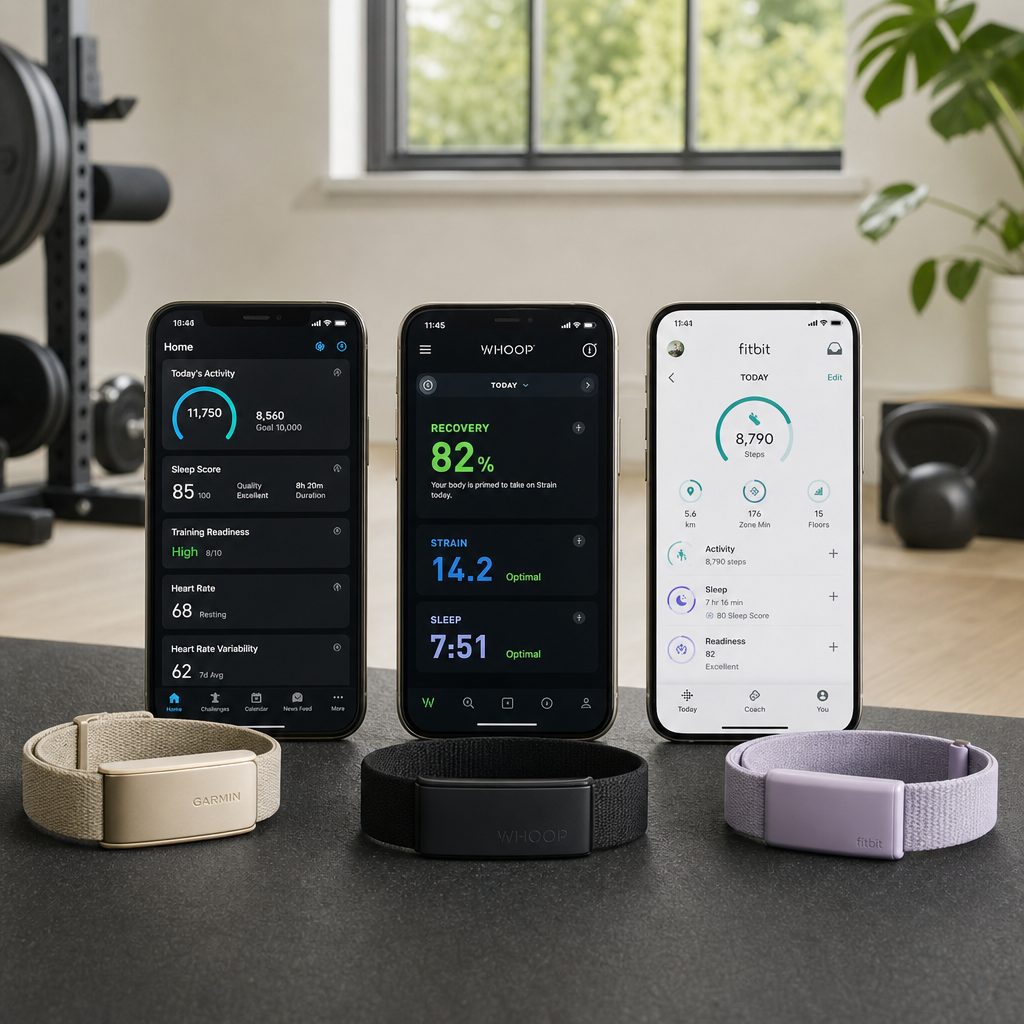
With no display to consult, the companion app becomes the dashboard. Garmin leans into Garmin Connect, WHOOP into membership-led interpretation, and Fitbit Air into cross-platform accessibility.
There is also a psychological difference between the approaches. Garmin's app can be a place you visit to review your data. WHOOP's app is more likely to become an active coach-like presence in your day because the membership is paying for ongoing interpretation and feature development. Fitbit Air's low initial cost makes the barrier to trying screen-free tracking much smaller. None of those approaches is inherently better. They simply suit different levels of appetite for data, guidance and recurring payments.
Do not underestimate app fatigue
A tracker that needs an app but gives you clear, useful answers can improve your routine. A tracker that encourages you to inspect every small fluctuation can become another admin task. Choose the ecosystem whose level of detail you will realistically enjoy rather than endure.
9. The best pick for different buyers
The sensible conclusion was not "buy this one and everyone else is wrong". The sensible conclusion was to match the tracker to the job. This category had three legitimate winners, depending on whether the deciding factor was cost, sport breadth, subscription freedom or physical comfort. Choosing the wrong one did not mean it was a bad product; it meant you had bought a very expensive answer to somebody else's question.
Best on a budget: Google Fitbit Air
Shop Google Fitbit Air on Amazon UK
At $99.99 / £84.99 and 12g with the band, Fitbit Air was the clearest pick for buyers who wanted a lightweight screen-free wearable with the lowest purchase price and Android/iOS compatibility.
Best gym all-rounder: Garmin CIRQA
Shop Garmin CIRQA on Amazon UK
CIRQA's 80-plus auto-detected sport types, favourite-activity button, Training Readiness, ANT+ broadcasting and subscription-free core metrics made it the most rounded choice for regular gym users.
Best for data depth: WHOOP 5.0
WHOOP 5.0 was the choice for people happy to pay continuously for recovery, strain, sleep, stress, VO2 Max, Healthspan Tracking and 145-plus supported activities.
Best for subscription-free recovery: Garmin CIRQA
If you wanted sleep quality, HRV status, recovery time and acute load distilled into Training Readiness without a mandatory membership, CIRQA was the obvious match.
Best for alternate wear positions: WHOOP 5.0
WHOOP Body apparel enabled wrist, torso, waist and calf wear, which made 5.0 particularly attractive for people who did not want a sensor on the wrist for every session.
Best battery claim: WHOOP 5.0
The 14-day quoted battery life was the longest here, ahead of CIRQA's up-to-10-day figure and Fitbit Air's up-to-seven-day claim.
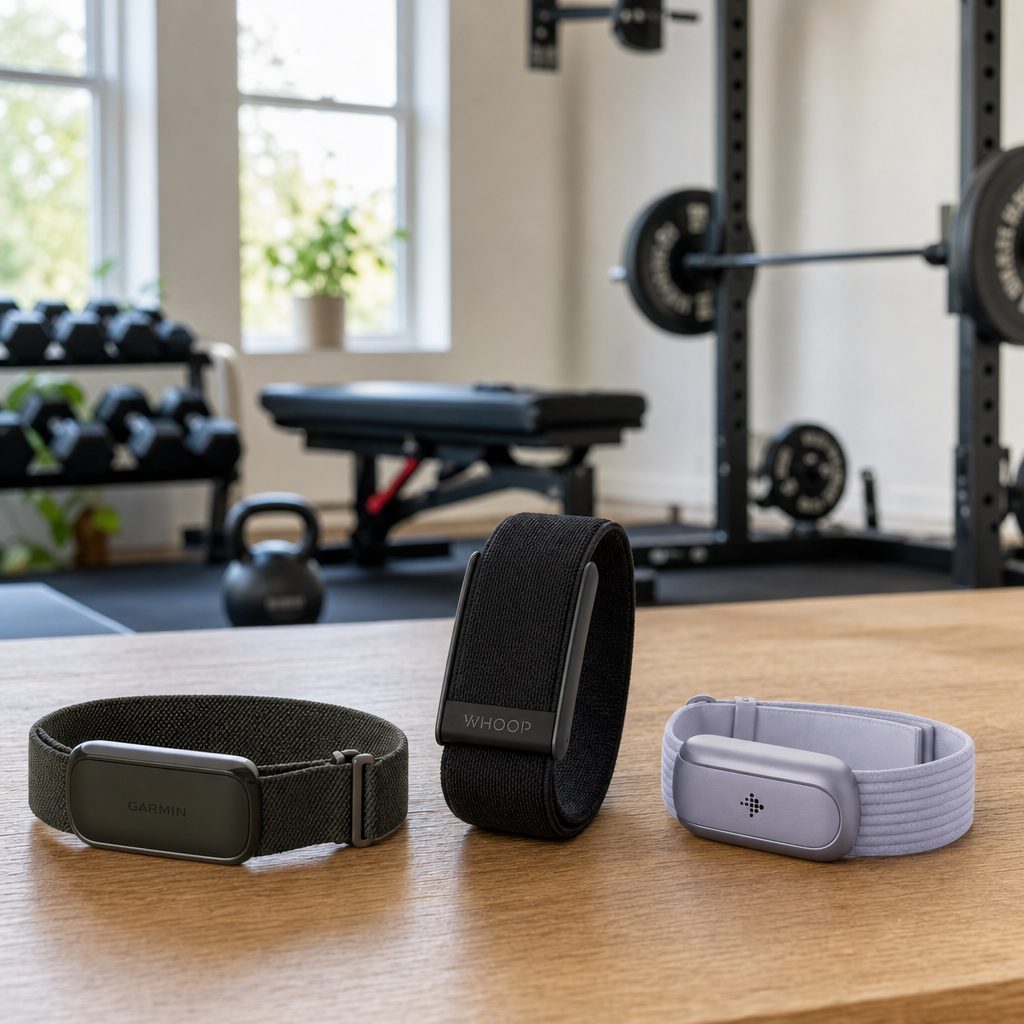
The right screen-free tracker depends less on brand loyalty than on the job you need it to do: low-cost daily wear, subscription-free training insight, or a deeper membership-led performance system.
For somebody building a home-gym programme or training in a commercial gym several times a week, I would start with Garmin CIRQA. The ability to manually begin a favourite activity, automatically detect a wide range of sports, view Training Readiness and broadcast heart rate over ANT+ made it feel immediately useful around real workouts. It was not the biggest activity catalogue, but it was the most balanced gym proposition without compulsory ongoing cost.
For endurance-minded athletes, mixed-discipline trainers or people who wanted to wear a sensor away from the wrist, WHOOP 5.0 made the stronger case. The 145-plus activity figure, 14-day battery claim, recovery-and-strain orientation and body-location flexibility created a highly capable system. The price was the commitment. At $398 for two years of WHOOP One, it was not a casual purchase. But a committed user who genuinely used the data could see exactly where the money went.
For first-time screen-free tracker buyers, Fitbit Air was difficult to ignore. Its £84.99 UK price was less intimidating than CIRQA's £179 and dramatically lower than two years of WHOOP membership. At 12g with the band, it was also the least likely to make its presence known while you slept. If your goal was to see whether screenless tracking suited your life before spending more, Fitbit Air was the rational place to begin.
10. Where each tracker made compromises
No comparison is useful if it only repeats the nice bits. Each tracker asked you to accept a trade-off, and the right purchase was often determined by which compromise bothered you least.
Garmin CIRQA's limitation was not its feature list; it was the context of its sensor choice. CIRQA used Garmin's Gen 4 optical sensor with skin temperature, one generation behind the Gen 5 sensor used in the Garmin Index Sleep Monitor. The optical arrangement appeared to match the approach used in watches such as the Forerunner 170, with two LED areas and four surrounding light sensors. Gen 4 was not automatically inadequate. It was a widely used platform capable of useful results. But in a £179 band whose core job was to monitor your body, buyers were justified in noticing that Garmin had not used its newest generation.
WHOOP 5.0's compromise was much easier to articulate: it cost money every year. The $199, $239 and $359 annual tiers were not a footnote. They were the purchase decision. If you chose WHOOP One, Peak or Life, you had to believe the membership-led interpretation, feature updates, support and hardware model were worth sustaining. For some serious athletes, they were. For people who wanted a tracker they could buy once and keep using, they were very much not.
Fitbit Air's compromise was its simpler stated proposition. The tracker was exceptionally light, screen-free, Android-and-iOS compatible and attractively priced, but it did not bring the explicitly detailed auto-detection, recovery tools, sensor list or training ecosystem claims that Garmin and WHOOP did in this comparison. That made it a brilliant uncomplicated option, not the default pick for someone shopping specifically for the deepest gym or sleep analysis.
WHOOP 5.0 strengths
- 14-day stated battery life and a redesigned processor claimed to be 10 times more power efficient.
- 145-plus supported activities, continuous strain and recovery monitoring, and Healthspan Tracking.
- Wearable across wrist, torso, waist and calf with WHOOP Body apparel.
WHOOP 5.0 limitations
- Membership was required, with two-year costs from $398 on WHOOP One.
- At 26.5g, it was the heaviest tracker in this trio.
- ECG capability belonged exclusively to the separate WHOOP MG.
The good news was that none of these compromises was hidden. Garmin told you through its pricing structure that its core data did not demand a subscription. WHOOP told you plainly through membership pricing that it was a service as much as a wearable. Fitbit Air told you through its tiny 12g worn weight and £84.99 price that it aimed at an accessible, low-fuss entry point. The trick was believing them when they told you who they were.
11. Garmin CIRQA vs WHOOP 5.0 vs Google Fitbit Air: final verdict
Garmin CIRQA was the best overall buy for most regular gym-goers who wanted a screen-free tracker that could contribute properly to training decisions without a mandatory subscription. It was not the lightest, cheapest or longest-lasting band here, and WHOOP's activity total was higher. Yet CIRQA put together the most practical mix of 80-plus auto-detected sport types, a favourite-activity button, Training Readiness, continuous health metrics, 5ATM water resistance, ANT+ heart-rate broadcasting and up-to-10-day battery life. Better still, the central experience lived in Garmin Connect without an annual payment being required.
WHOOP 5.0 was the better choice for a particular type of committed user: someone who wanted a comprehensive, always-on performance and health platform, could justify the recurring cost, and valued 145-plus supported activities, a 14-day battery claim and flexible body placement. It was not simply a tracker. It was a subscription-led coaching and interpretation ecosystem. If that is exactly what you want, Garmin's lower cost will not necessarily feel like better value. If that sounds exhausting, the membership will feel like a very expensive way to be told to sleep more.
Google Fitbit Air won the affordability and minimalism prizes. At $99.99 / £84.99 and 12g with the band, it was the clearest choice for someone who wanted to enter screen-free tracking as cheaply and unobtrusively as possible. It also worked with Android and iOS. For low-cost everyday wear, that was a cracking package. For detailed gym auto-detection and explicitly named sleep-and-recovery tools, though, Garmin and WHOOP offered more clearly defined systems.
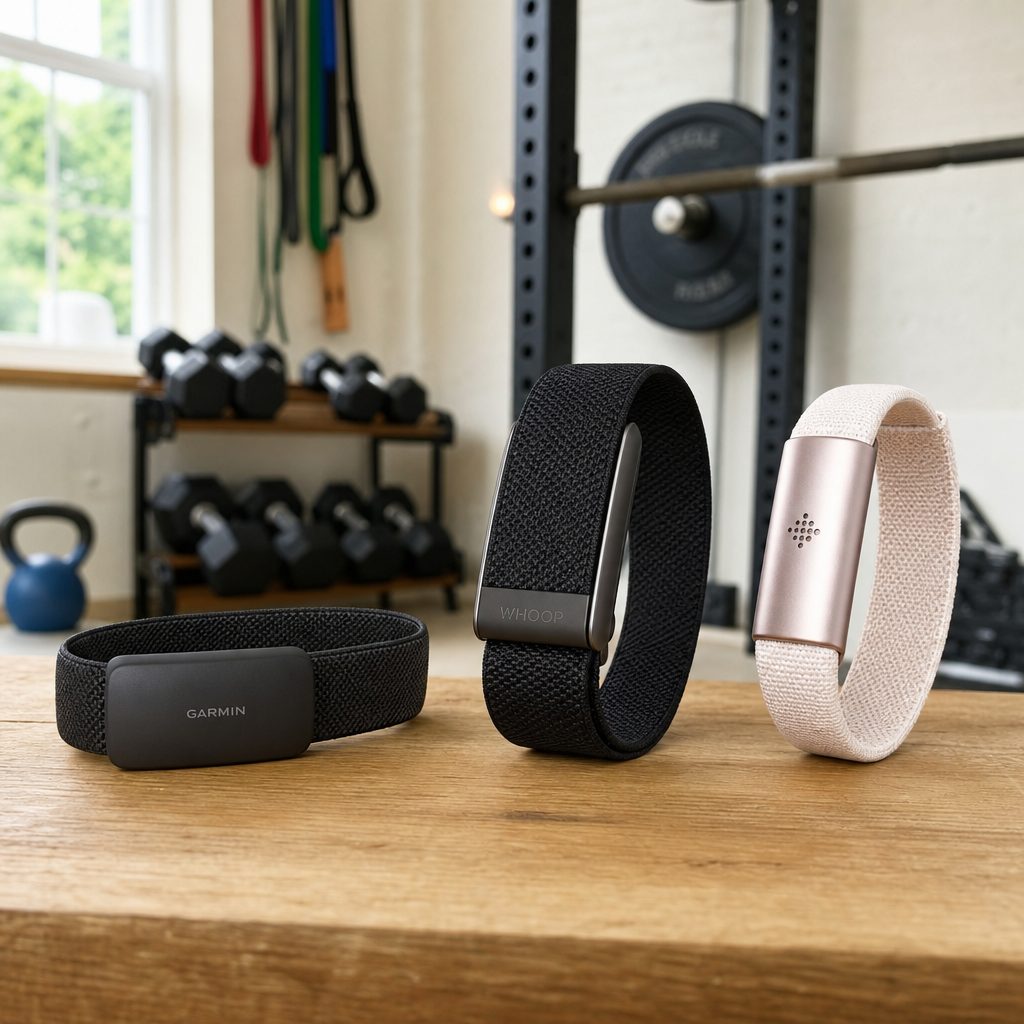
The final choice is not about which logo belongs on your wrist; it is about whether you value low cost, subscription-free training insight, or a deeper membership-based performance platform.
Bottom line
Buy Garmin CIRQA if you want the best balanced screen-free tracker for regular gym training, recovery guidance and subscription-free core metrics. Buy WHOOP 5.0 if you want the most expansive activity and recovery platform, alternative wear locations and are comfortable paying for membership over time. Buy Google Fitbit Air if your priorities are the lowest entry price, Android-and-iOS compatibility and an exceptionally light 12g worn tracker.
There was no absolute winner because these bands were selling different ideas. CIRQA was the practical ownership winner. WHOOP was the data-service winner. Fitbit Air was the low-cost minimalist winner. Pick the one whose ongoing reality you will still like after the first exciting week has passed.