
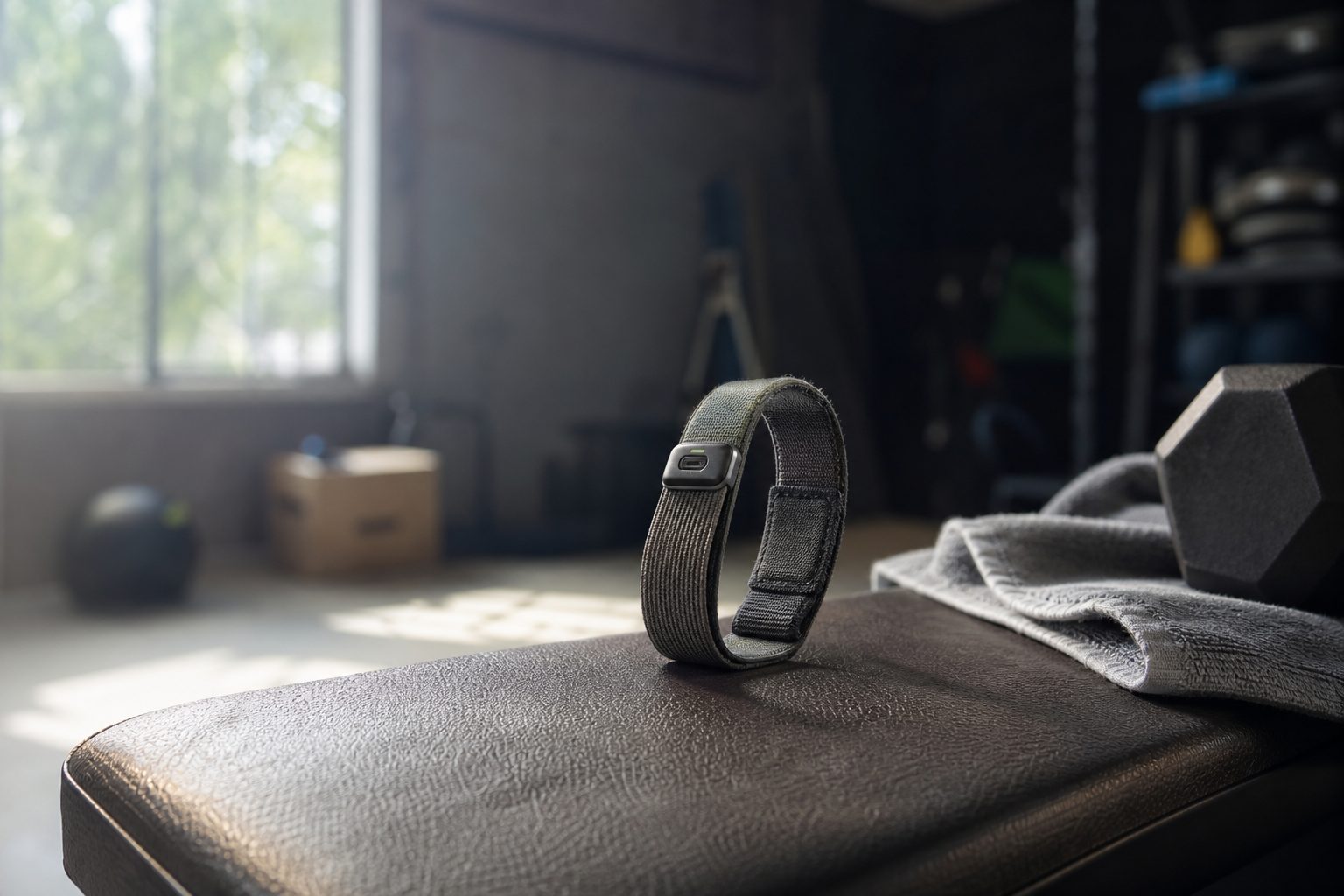
Garmin's CIRQA traded the usual smartwatch face for a lightweight fabric band, leaving the Garmin Connect app to do the explaining.
Garmin CIRQA Smart Band Review: The Screen-Free Tracker With No Subscription
Garmin's first screenless band arrived in July 2026 with a clear pitch: continuous health and training data, a claimed 10-day battery, and no recurring subscription for the useful bits. The CIRQA is wonderfully unobtrusive, genuinely interesting for gym regulars, and not quite the sensor-led slam dunk Garmin's wider reputation might suggest.
 By James Oduya · Staff Writer & Home Gym Columnist · Updated July 31, 2026
1. Garmin CIRQA at a glance
The Garmin CIRQA was announced on 21 July 2026 and became available to order on 24 July 2026. It arrived at a time when the screen-free fitness band had become a surprisingly busy little corner of the wearables market. Some people wanted a smartwatch that could do everything, including interrupt a perfectly respectable dinner with a notification. Others had rather sensibly decided that they wanted the tracking but not the tiny glowing square permanently asking for attention.
CIRQA belonged firmly in the second camp. It was Garmin's first screenless band: a 15–20g fabric wearable, depending on size and strap configuration, designed to gather continuous health information without becoming another thing to look at. There was no touchscreen, no watch face, no little rainbow of widgets. There was one physical button, a discreet LED battery indication triggered with a double tap, and the Garmin Connect app for everything else.
That simplicity was the point. Yet it did not mean a simple tracker. CIRQA monitored continuous heart rate, heart-rate variability, sleep, stress, blood oxygen saturation and skin temperature. It supported more than 80 activities, could automatically detect and log a variety of movement types, could broadcast heart rate over ANT+, and could be worn at the wrist or, with Garmin's optional bands, on the upper arm. In other words, it wanted to be a training companion rather than a minimalist step counter that had got above its station.
The wrinkle was the sensor. Garmin used its Elevate V4 optical sensor here, one generation behind its latest technology. That was not automatically a disaster. The V4 platform had been used widely and was capable of perfectly useful results in the right conditions. But in a £179 tracker whose primary job is to measure your body, sensor choice matters more than the absence of a screen. A band can be beautifully quiet and wonderfully comfortable; if its heart-rate reading goes wandering during a hard session, the calm begins to feel slightly less enlightened.
For Total Gym Gear readers, the headline is fairly straightforward. CIRQA makes sense if you train often enough to care about recovery, sleep and heart-rate trends, but you do not want a chunky watch against a barbell, kettlebell handle or lifting strap. It makes less sense if you need instant pace, interval prompts, maps, elevation data or a reliable standalone running computer. It is not trying to be a watch with the screen removed. That distinction is important.
CIRQA has no onboard GNSS, barometric altimeter, compass or gyroscope. Outdoor distance and pace depend on connected GPS from a paired phone, and it has no multisport profile. It is therefore strongest as an always-on health and gym-training band rather than a standalone endurance-sport device.
2. Design and fit: Garmin's most discreet training wearable
The best thing about CIRQA's design is that it understands when to disappear. Most gym gear benefits from a degree of visual drama. A power rack should look reassuringly solid. A spin bike can look purposeful. A heart-rate tracker does not need to shout. The CIRQA module was only 27mm wide and sat within a 24mm strap, while the overall band remained just 0.2cm thick. It was much closer to a fabric bracelet than a conventional sports watch.
There were two sizes. The small/medium band measured 36.0 x 2.4 x 0.2cm and fitted wrists from 120–200mm in circumference. The larger L/XL band measured 50.0 x 2.4 x 0.2cm and fitted 145–240mm wrists; its total weight was 21.2g. The size overlap was sensible. It gave people in the middle a little choice between a more compact tail length and a more relaxed fit, rather than forcing everyone into the usual wearable-world compromise of "probably fine".
Fabric was a sensible material choice for an all-day tracker. Metal links look handsome but make no sense near a kettlebell. Silicone can be practical but sometimes turns into a damp little bracelet after a sweaty session. A light woven band has more give, feels less clammy during sleep and is easier to forget you are wearing. Forgetting it is on is not a marketing flourish in this category; it is almost the entire job description.
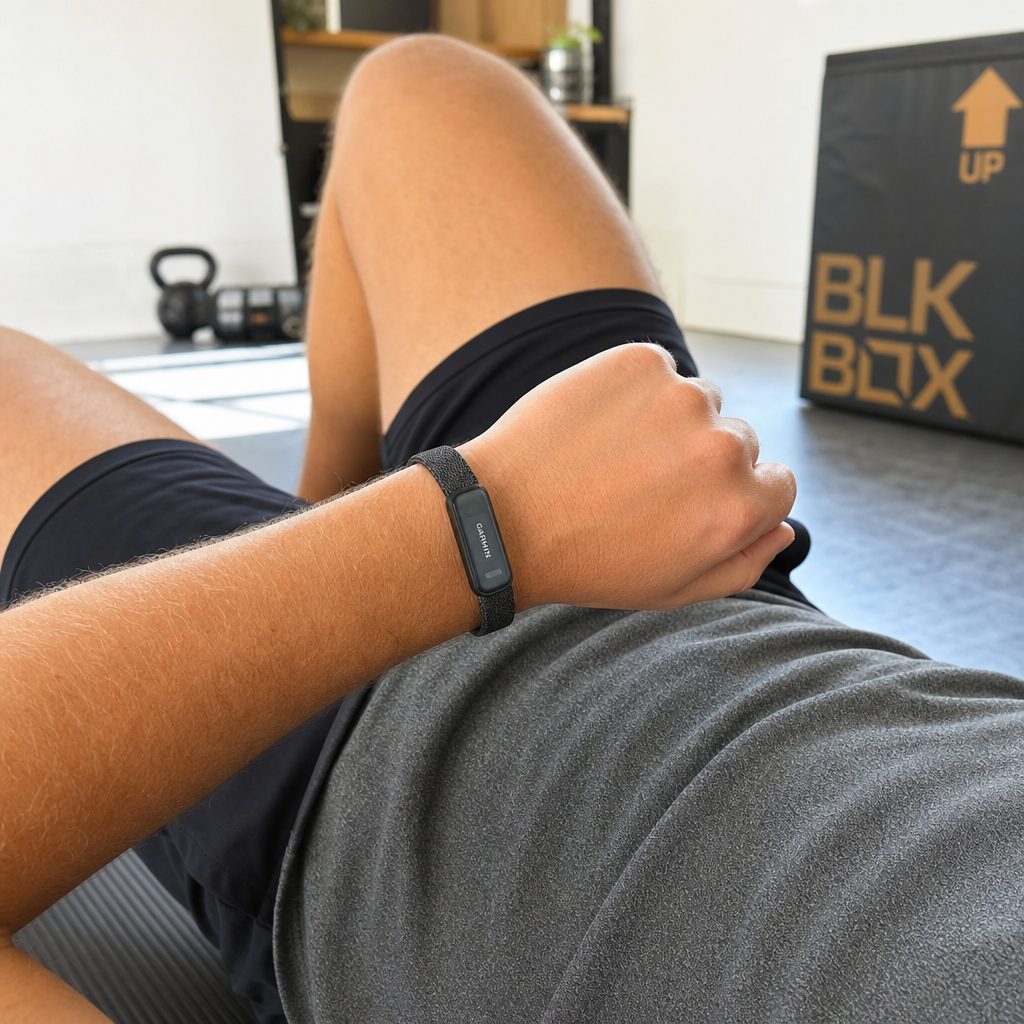
The CIRQA's narrow central module and fabric strap kept it far less intrusive than a conventional sports watch during all-day wear and sleep.
Its available fabric colours included Citron Gray, Mauve, French Gray, Dark Olive, Captain Blue, French Blue and Black. Garmin also described core options in black, French Gray, berry and navy. The broader point is that CIRQA looked deliberately more lifestyle-friendly than a rugged outdoor watch. It was not dressed up as jewellery, thankfully. It still looked like training equipment. But it was soft around the edges in a way Garmin's more technical wearables often are not.
The lack of a screen changed how the band felt in use. There was no temptation to turn the wrist every thirty seconds during an interval. No distraction when you were trying to focus on a difficult set. No accidental brushing of a display whilst pulling a lifting strap tight. For strength training especially, that can be a relief. Anyone who has caught a watch case on a front-rack position or pressed a button with a wrist wrap knows that wearable convenience has limits.
There was still a single side button. Its main job was to start a favourite activity from the wrist. That was a sensible compromise. A wholly button-free tracker can be sleek but occasionally irritating; you either rely entirely on automatic detection or take your phone out just to say, yes, I am now exercising on purpose. CIRQA let you begin your preferred activity without needing to perform a small administrative task on the app first.
A double tap on the module reported battery status through LED colour. That is a modest feature, but it fits the product rather well. Garmin did not try to fake a screenless display through complicated tap patterns or mystic vibration language. The band offered a practical check, then got out of the way. As with a good adjustable bench, the cleverness was in being useful without making a song and dance about it.
Fit matters more than usual with a screenless tracker
Because CIRQA has no live heart-rate field to warn you that contact has gone poor, spend a few minutes finding a secure position before a hard gym session. A snug but comfortable fit above the wrist bone is the sensible starting point. For lifting, Garmin's upper-arm option is the more convincing route if you want the best chance of stable optical readings.
The ability to move CIRQA to the upper arm was more than a novelty. Garmin offered upper-arm bands at $49.99 or $59.99 depending on wear location, while additional bands in Citron Gray, Dark Olive and French Blue were also priced at $49.99 or $59.99. That was not cheap for fabric, let us be honest. But an upper-arm position can be genuinely useful in the gym, where wrists bend, grip hard, sweat heavily and regularly support equipment. Optical sensors are often happiest where the body is less busy doing all of those things at once.
3. Screen-free does not mean training-free
It would be easy to assume that a band without a display was only suited to sleep tracking, gentle walking and occasionally feeling guilty about a stressful afternoon. CIRQA was more ambitious. It supported more than 80 activities, used automatic detection to record a variety of sessions, and stored the detail in Garmin Connect for review and editing afterwards. That makes it a different proposition from a basic activity band, even if its quiet appearance initially suggests otherwise.
For gym users, there are two distinct ways to use it. The first is deliberate: press the side button to start a favourite activity, train, then inspect the session in Garmin Connect. The second is more relaxed: wear the band consistently, allow it to identify activity, then correct or edit the result later. Garmin said CIRQA learned from those corrections. This is useful because real-world training is rarely as tidy as wearable menus pretend.
A gym session can include a ten-minute walk to warm up, mobility work, resistance training, a chat about somebody's holiday, a few sets of rowing, then a bike finisher because the squat rack was occupied. A band that expects a clean start and stop for every segment is living in a nicer, more organised world than most commercial gyms. CIRQA's ability to detect and subsequently edit activity is therefore a practical strength.
More than 80 activity types
CIRQA covered a wide spread of exercise categories, so it was not confined to steps, general cardio and a vague "workout" label. The benefit is broader training context inside Garmin Connect.
Automatic activity detection
The band could detect and log a variety of activities without every session needing to start with a phone interaction. Recorded activities could then be viewed and edited afterwards.
One-button favourite activity start
The side button offered a direct route into a chosen activity. It was a small but meaningful concession to people who want some control without wearing a display.
ANT+ heart-rate broadcast
CIRQA could broadcast heart rate to compatible Garmin equipment and other ANT+ devices, potentially making the band a lightweight sensor for a wider training setup.
The absence of a screen does require a change in expectations. With a watch, you can react to data as it happens: hold a pace, stay in a target zone, note a cadence change or decide whether an interval went well. CIRQA is more reflective. It collects the session and asks you to look afterwards. That suits strength work, steady indoor cycling and general conditioning surprisingly well. It is less natural for a runner trying to hit exact pace targets or a cyclist navigating a route.
There was no onboard GPS, so CIRQA relied on connected GPS from a paired smartphone for outdoor distance and pace. That is not a minor technical footnote. If you run outdoors and dislike taking your phone, CIRQA does not solve the problem. It simply makes you carry the phone in a different outfit. Likewise, there was no barometric altimeter for elevation tracking, no compass and no gyroscope. Trail runners and hikers should be clear-eyed about that before becoming too enchanted by the neat fabric band.
The lack of a multisport profile is another indication of intended use. CIRQA could record many individual activity types, but it was not built to handle a structured swim-bike-run event as one continuous multisport activity. That will not matter to most gym members. It will matter quite a lot to anyone who does events where changing kit in a car park at an absurd hour is somehow considered leisure.
What it did offer was a different form of freedom. A screen makes a wearable feel like a tiny command centre. CIRQA felt like a sensor. It was there to notice patterns across days and weeks, not to demand that every session be performed in front of a glowing dashboard. For the right person, that is liberating. For the person who loves metrics in the moment, it may feel like Garmin has hidden the pudding until after dinner.
4. Heart-rate accuracy and the Elevate V4 question
Shop Heart-rate accuracy and the Elevate V4 question on Amazon UK
This was the part of the review that needed the most care. Garmin's Elevate V4 sensor was not new or unknown technology, but it was one generation behind the company's latest sensor platform. That decision made sense from a product-positioning point of view: CIRQA was lighter, screenless and £179 rather than a full premium sports watch. Yet a tracker of this type lived or died on the credibility of the trends it collected. If the heart-rate data is questionable, sleep, stress and recovery interpretation begin from a less secure foundation.
The good news was that CIRQA showed credible results in some controlled gym-relevant use. In strength-training testing reported by Tom's Guide, the CIRQA recorded an average heart rate of 89.31bpm against 92.62bpm from a chest strap. That is a 3.3bpm difference, or roughly 3.5% error. For the messy stop-start nature of resistance training, that is respectable. Optical wrist sensors are often challenged by gripping, wrist flexion, sudden changes in effort and the simple fact that your forearms spend much of the workout behaving like they have independent political ambitions.
That result is especially encouraging if you view CIRQA as a way to quantify the overall cardiovascular load of a lifting session rather than as an instrument for analysing every individual set. Few people need a perfect beat-by-beat graph whilst doing dumbbell rows. They do want a reasonable view of whether a long circuit session was genuinely demanding, whether their heart rate came down between rounds, and whether a month of training has improved their recovery. In that context, an average only 3.3bpm below a chest strap is useful.
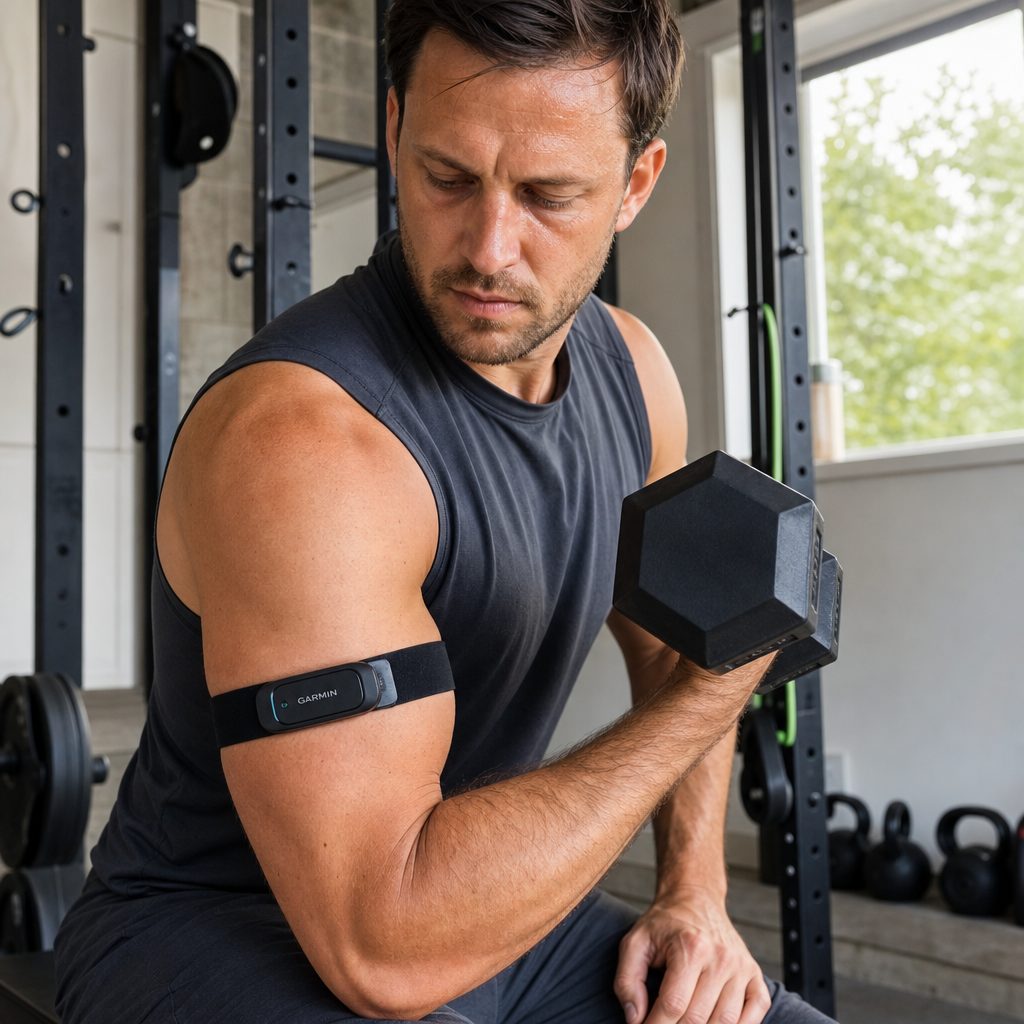
Upper-arm wear is the more sensible configuration for strength sessions, where gripping and wrist flexion can make optical readings work harder than they should.
Tom's Guide also found the upper-arm placement more accurate than wrist wear and recommended a biceps band for strength work. That aligns neatly with common sense. The upper arm is usually less affected by the repeated wrist movement, compression and contact with equipment that lifting involves. Garmin's optional arm-band ecosystem therefore was not merely a way of selling another strap. It addressed a real limitation of optical monitoring during gym training.
Easy runs and interval sessions were also reported as generally impressive for wrist-based heart-rate accuracy by Tom's Guide. This is worth mentioning because interval running is not a gentle test. A sensor needs to respond to changing effort rather than simply settle into a pleasingly stable number on an easy jog. The CIRQA apparently handled those sessions well enough to inspire confidence, which suggests that the V4 sensor was not intrinsically unfit for purpose. Far from it.
Indoor cycling produced similarly positive feedback from Geeky Gadgets, which described the heart-rate tracking as accurate and reliable. Again, that is a use case where CIRQA's format makes sense. A screenless band is unobtrusive under cycling gloves or when holding handlebars, and the relative stability of the wrist can make life easier for an optical sensor than it is during explosive lifting.
However, the open-water result was much less flattering. In an open-water swim test published by The5kRunner on 30 July 2026, CIRQA under-read by 20–30bpm when compared with a Polar Sense, WHOOP MG and Apple Watch Ultra 3. CIRQA was worn on the right wrist; the Polar Sense was worn on the right biceps, while the WHOOP MG and Apple Watch Ultra 3 were on the left biceps and left wrist respectively. Placement differences mean this was not a laboratory-perfect like-for-like setup, but the scale of the under-reading was large enough that it could not be shrugged off as normal wearable noise.
The lesson is not that CIRQA cannot be trusted at all. That would be too broad, and the better gym and running results do not support it. The lesson is that the device's accuracy was activity-dependent, which is true of practically every optical tracker but more important here because Garmin had chosen an older sensor generation. For lifting, indoor cycling, easy running and interval work, the evidence was encouraging. For open-water swimming, the evidence was a warning sign.
If swimming is your primary sport, I would not buy CIRQA on the strength of its heart-rate recording alone. The 5 ATM water resistance made it suitable for water exposure, but water resistance and accurate optical heart-rate capture are separate things. One stops water getting in. The other asks light, skin, motion and sensor contact to cooperate while you are flailing through a lake. They are not the same achievement.
For gym users, the practical answer is refreshingly simple. Wear it correctly, consider the upper arm for strength work, use the data as a training trend rather than courtroom evidence, and broadcast heart rate to a compatible ANT+ device if that fits your setup. If you require the highest possible precision for threshold training, racing or clinically minded comparison, a chest strap remains the more specialised tool. CIRQA did not overthrow that truth. It made a convincing case for a more comfortable daily alternative.
5. Sleep, stress and daily recovery: the value of wearing it constantly
Where CIRQA's low-key design really earned its keep was outside the gym. A wearable only provides useful long-term health and recovery context if you actually keep it on. That sounds obvious, but it is where plenty of clever devices fall down. A heavy watch can feel bothersome in bed. A bright display can invite late-night checking. A stiff strap can leave you wanting to take the thing off halfway through a film. Then the tracker gives you incomplete sleep data and looks very pleased with itself anyway.
CIRQA monitored continuous heart rate, HRV, sleep, stress, SpO2 and skin temperature. That is a meaningful set of measurements for anyone trying to understand how training, work, sleep and life generally are interacting. It is not a diagnosis. No consumer wearable should be treated as one. But it can provide useful routine and context when you look at it with a bit of patience.
Heart-rate variability, in particular, is most useful as a trend rather than a score to panic about each morning. One low reading after a poor night, a difficult training session or a stressful day does not mean you have broken yourself. A sustained change alongside poor sleep and higher stress is more informative. The value of CIRQA was that it collected these pieces quietly. It did not require you to remember to put on a watch every evening, nor did it light up the bedside table like a small landing beacon.
Sleep tracking also benefits from the band's low weight. The module-only weight was 14.8g, while the complete wrist band sat in the 15–20g range depending on configuration. Those are not just nice brochure numbers. They are the difference between wearing a device overnight and being continually aware that you are wearing one. For people who have abandoned sleep tracking because a full smartwatch felt bulky, CIRQA was a very sensible alternative.
The stress feature should be approached in the same sensible spirit. It can reveal patterns: perhaps hard morning training, coffee, a long commute and a poor lunch combine into a less restful afternoon than you expected. It can also encourage an unhelpful tendency to treat a wearable's interpretation of your day as superior to your own. If the band says stress is high but you feel fine, do not immediately schedule a rescue mission. Look at the longer pattern, not one isolated blip.
Sleep tracking without a bedside distraction
The fabric construction and screen-free format were particularly well suited to overnight use, where lightness and lack of visual noise can matter more than smartwatch versatility.
Continuous HRV and heart-rate context
CIRQA collected the long-view physiological information that helps make recovery trends more useful than a single post-workout number.
Skin temperature monitoring
Skin-temperature data added another layer of context to nightly and daily health tracking, although it should be interpreted as a personal trend rather than a medical verdict.
SpO2 monitoring
Blood oxygen saturation tracking was included alongside sleep, stress and heart-rate metrics, placing CIRQA well beyond the usual basic activity-band remit.
The important advantage was that Garmin included these core metrics without a subscription. That should not be treated as a trivial bonus. Wearables increasingly have a habit of selling you hardware, collecting your body data, then placing the most useful interpretation behind a monthly charge. It is a business model, certainly. It is also mildly irritating when you have already paid for the device strapped to your arm.
Garmin's approach with CIRQA was much cleaner. Buy the band, use Garmin Connect, see the core health, sleep and training information. That made the product easier to recommend to anyone who wants to know the full cost before they start. It also makes ownership psychologically easier. You can wear CIRQA for months, build a useful personal baseline and not feel as though a small meter is ticking away in the background.
There is a caveat. Screen-free tracking asks you to develop a healthy relationship with the app. You will need to review data there. If you are someone who buys a tracker hoping it will fix your sleep simply by existing near you, this will not work. No tracker will. CIRQA can surface patterns; you still have to decide whether those patterns mean an earlier bedtime, a lighter training day, a change to caffeine habits or simply accepting that a chaotic week was chaotic.
6. Battery life and real-world routine
Garmin rated CIRQA for up to 10 days of battery life. In this class, that is one of the most useful specifications on the page. It is also more meaningful than people sometimes realise. Battery life does not merely determine how often you find a cable. It determines whether the tracker has enough uninterrupted time on your wrist to produce a coherent picture of your sleep, recovery and training.
A device that needs frequent charging can leave gaps precisely when the data would have been most useful. You finish a hard late workout, take the watch off to charge, forget it on the kitchen counter, and wake up without sleep information. Nobody has died from that disappointment, to my knowledge, but it defeats the purpose of buying an always-on health tracker.
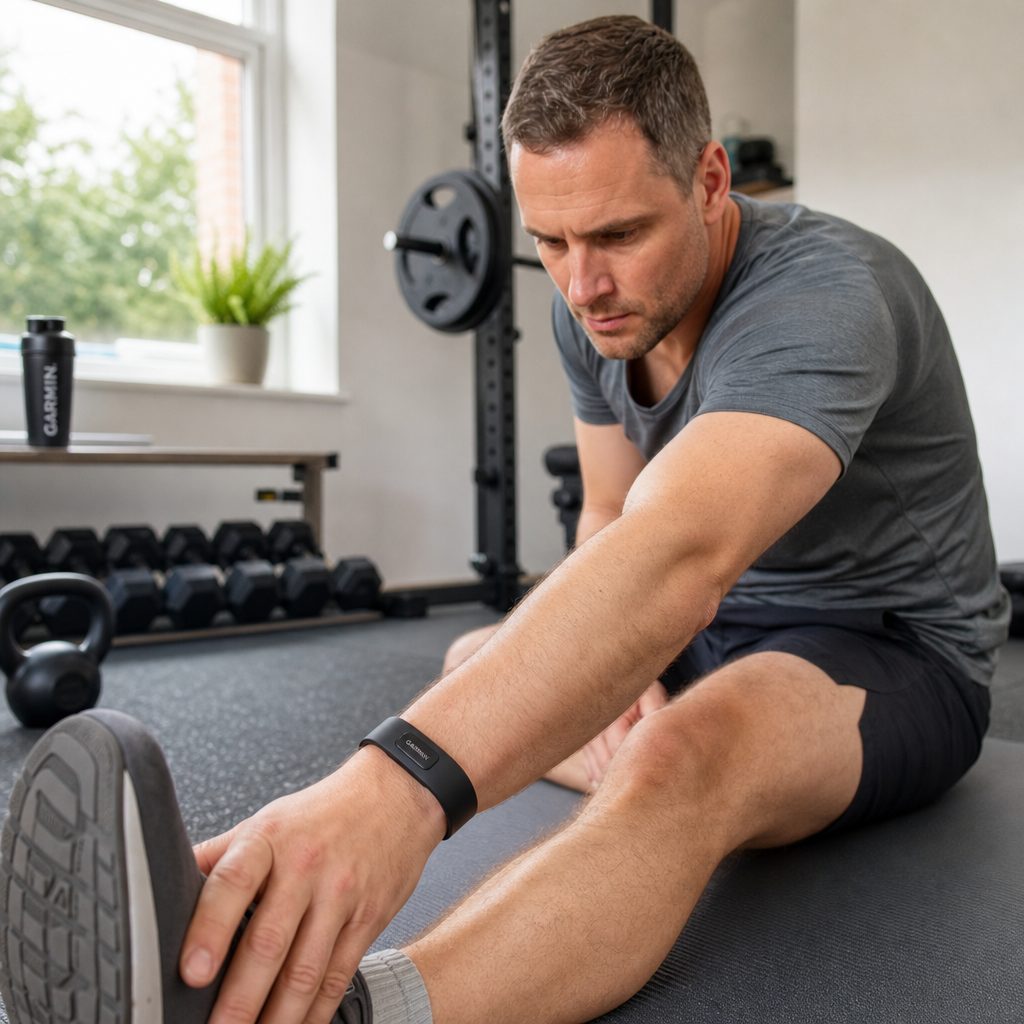
A claimed 10-day battery life made CIRQA better suited to continuous sleep and recovery tracking than devices that repeatedly demand a place on the charger.
CIRQA charged through a proprietary Garmin USB-C cable. This is the least exciting part of the product, but it is worth saying plainly: proprietary charging hardware is always a little less convenient than standard USB-C directly into the device. Garmin's cable at least used USB-C on the power side, which is better aligned with the cables most households now have nearby. Still, it is another small lead to keep track of. If you lose it before a holiday, you will have a brief and entirely avoidable argument with a drawer.
Actual battery endurance depended on feature use, software settings and individual wear patterns. That is normal. Continuous health monitoring is not free in energy terms, and different activity habits will change how much work the device does. But the key thing is that the claimed ceiling of 10 days placed CIRQA in a sensible rhythm: charge occasionally, rather than arrange your life around it.
Daily use was shaped as much by the lack of screen as by the battery. CIRQA could not show a notification, tempt you into changing a music track, present an incoming call or nudge you into browsing the weather. Some people will read that list and wonder why on earth they would buy it. Others will feel their shoulders relax. Garmin clearly judged that there was a meaningful group who already had a phone and did not require a second, smaller, more inconvenient phone on the wrist.
The screen-free approach also made the band easier to wear in the gym. There was no concern about scratching a display on a barbell knurl, catching an expensive watch case on a cable machine or wiping chalk from glass. CIRQA was not invulnerable, of course. It remained an electronic device and should be treated with ordinary care. But the fabric-and-module construction was less precious than a traditional smartwatch.
The double-tap battery indicator was a good example of Garmin keeping the physical interaction appropriately restrained. You could check battery status by LED colour without opening the app, yet the band did not invite constant fiddling. That balance suits people who are trying to spend less time checking small screens, not merely move their checking from phone to wrist.
For travel, a 10-day claim was particularly appealing. If you are away for a week, CIRQA should fit naturally into the packing routine without making a charger a high-priority item. That matters for training camps, work trips and family holidays alike. A tracker is most helpful when it continues to record the slightly unusual sleep, activity and stress patterns that travel brings. Leaving it uncharged at home because it was needy is not a sophisticated health strategy.
What CIRQA did well
- Claimed battery life of up to 10 days supported genuine continuous wear rather than frequent charging breaks.
- The screenless, lightweight fabric design was excellent for sleep, lifting and people tired of smartwatch distraction.
- Core health, sleep and training data came without a recurring subscription.
- Upper-arm wear offered a more promising accuracy route for strength work.
- ANT+ heart-rate broadcast made the band more useful within a broader training setup.
Where it fell short
- The Elevate V4 sensor was a generation behind Garmin's latest platform.
- Open-water testing showed a substantial 20–30bpm under-read against comparison devices.
- There was no onboard GPS, so outdoor pace and distance required a paired phone.
- No screen meant no live training fields, pacing prompts or at-a-glance workout feedback.
- Optional upper-arm bands added meaningful extra cost.
7. Garmin Connect and the no-subscription advantage
Shop Garmin Connect and the no-subscription advantage on Amazon UK
CIRQA made sense only because Garmin Connect already existed as a mature place to review training and wellness information. The band itself is intentionally quiet. That means the app had to take on the burden of turning streams of heart rate, HRV, sleep, stress, SpO2, skin temperature and activity data into something a normal person could understand without requiring an afternoon and a spreadsheet.
For existing Garmin users, CIRQA's appeal was obvious. It could sit inside a familiar training ecosystem, collecting continuous data without replacing a preferred Garmin watch, bike computer or other device. The ANT+ heart-rate broadcast was particularly useful here. If you wanted CIRQA's low-profile daily wear but still used compatible Garmin equipment for a training session, the band could act as a heart-rate source rather than becoming an isolated health gadget.
For newcomers, Garmin Connect asked for a small learning curve. Garmin has historically tended to offer a lot of information, which is good when you want depth and slightly less good when you simply want to know whether a workout went well. CIRQA's screenless nature means you cannot avoid the app if you want detail. That is not a flaw exactly; it is the agreed arrangement. But it does mean the product suits people who are happy reviewing trends on a phone rather than people who need the answer at the end of every set.
The no-subscription model softened that adjustment considerably. CIRQA was priced at £179 in the UK, €199 in Europe, $199.99 in the United States, C$279.99 in Canada, MX$4,099 in Mexico and ¥32,800 including tax in Japan. That was the whole device price for access to its core metrics, rather than an entry fee to a membership relationship. At £179, it was not cheap in the abstract. But it was a more transparent proposition than a lower-priced band that gradually accumulates monthly charges.
Garmin CIRQA Smart Band
UK suggested retail price, with core tracking available without subscription.
Additional wrist or arm band
Optional Garmin strap pricing varied by wear location and band option.
United States price
Suggested retail price at availability in July 2026.
There is a useful philosophical difference between Garmin CIRQA and a subscription-led tracker. A subscription product often encourages you to think of the service as the product and the band as the key that unlocks it. CIRQA was the opposite. The band was the product; Garmin Connect was the place where you made use of what you had bought. That distinction will matter a great deal to people who have had enough of paying rent on their own sleep data.
It also made CIRQA a more straightforward long-term purchase. If you wore it for two or three years, the value improved with time rather than being steadily reduced by ongoing membership costs. Of course, hardware does not stay current forever, and the V4 sensor was already behind Garmin's newest technology at launch. But the absence of a mandatory monthly fee means the ownership maths is not constantly shifting under your feet.
There was another advantage for gym-goers. A screenless band with an app-centric workflow encourages post-session review rather than mid-session obsession. You can train by feel, execute the programme in front of you, then look at trends when you are finished. That is not right for every discipline, but it is often healthier for strength work. You do not need a wearable to congratulate you for every deadlift. The barbell will provide sufficiently clear feedback.
In short, Garmin Connect was not an optional extra to CIRQA. It was the other half of the product. Fortunately, the fact that it did not demand a subscription for the core experience made that relationship feel much less transactional.
8. Garmin CIRQA versus WHOOP MG, Polar Sense and Apple Watch Ultra 3
Comparing CIRQA directly with every wearable on the market would be slightly silly. A screenless fabric band, a full smartwatch and an arm-mounted sensor are solving different problems even when they collect similar physiological data. Still, the CIRQA's open-water test placed it alongside WHOOP MG, Polar Sense and Apple Watch Ultra 3, and those devices provide a useful lens for understanding its position.
In that 30 July 2026 open-water test, CIRQA was on the right wrist and under-read by 20–30bpm compared with the Polar Sense on the right biceps, WHOOP MG on the left biceps and Apple Watch Ultra 3 on the left wrist. It would be wrong to turn one swimming session into a complete universal hierarchy. Placement, water movement and individual physiology all matter. But the result reinforced an important point: the CIRQA's wrist-based V4 sensor could be less dependable in difficult conditions than dedicated upper-arm placement or the other tested devices.
For the gym, however, the comparison needs more nuance. CIRQA offered a no-subscription route to continuous data and can also move to the upper arm with the appropriate Garmin band. The Polar Sense's upper-arm positioning illustrates why that placement can be attractive in motion-heavy activity. WHOOP MG represented the subscription-oriented screenless approach. Apple Watch Ultra 3 represented the full smartwatch approach, with the obvious benefit of immediate on-device information but a very different physical and conceptual footprint.
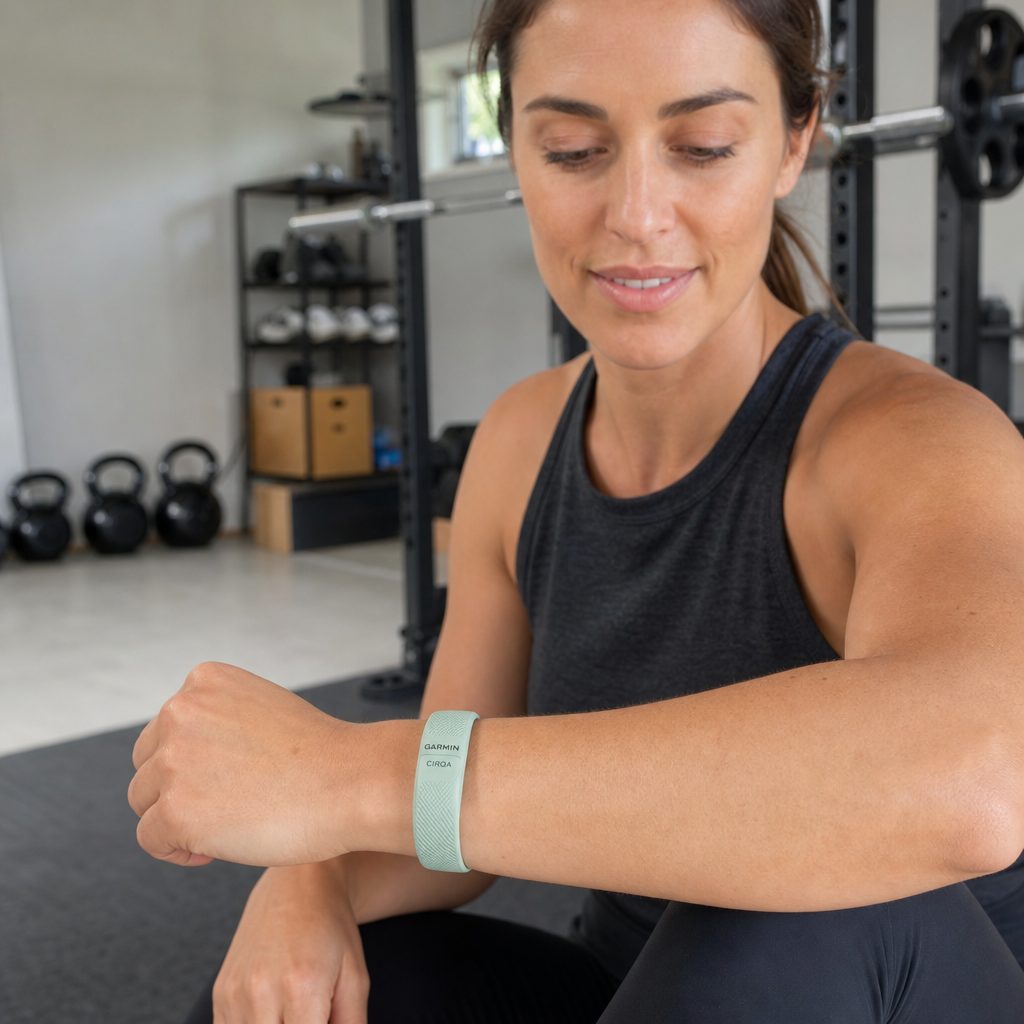
CIRQA occupied a useful middle ground: subtler than a smartwatch, more training-focused than a basic band, but dependent on fit and activity type for its best heart-rate results.
| Test or ownership point | Garmin CIRQA | Polar Sense | WHOOP MG | Apple Watch Ultra 3 |
|---|---|---|---|---|
| Open-water test placement | Right wrist | Right biceps | Left biceps | Left wrist |
| Open-water heart-rate result reported on 30 July 2026 | Under-read by 20–30bpm against the comparison devices | Used as a comparison device | Used as a comparison device | Used as a comparison device |
| Display approach | No onboard screen | Not assessed in the CIRQA test result | Screenless category competitor | Smartwatch comparison device |
| Subscription approach relevant to CIRQA buyers | No subscription required for core metrics | Not assessed here | Subscription-only competitor category | Not assessed here |
| Wear-position relevance | Wrist or optional upper arm | Right biceps in the cited test | Left biceps in the cited test | Left wrist in the cited test |
The most useful comparison is not "which tracker won?" It is "which compromise do you prefer?" CIRQA chose comfort, minimal distraction, a claimed 10-day battery and no subscription. Apple Watch Ultra 3 represented the immediate-feedback route: a wrist computer for people who want information on demand. WHOOP MG was relevant because it lived in the screenless world too, though CIRQA's no-subscription stance was the key differentiator. Polar Sense's biceps placement highlighted why arm-based sensing is attractive when wrist accuracy becomes temperamental.
For a strength trainee, CIRQA's ability to use an upper-arm band is particularly important. The improvement reported by Tom's Guide when moving CIRQA from wrist to upper arm was not a surprise, but it was a useful confirmation. If you are going to buy a band like this largely for gym heart-rate data, I would view the upper-arm accessory as a serious consideration rather than a decorative extra. It costs more, yes, but it potentially turns a good daily tracker into a more convincing workout tracker.
For a swimmer, the comparison told a harsher story. A 20–30bpm under-read is large enough to affect training zones and overall load interpretation. CIRQA's 5 ATM water resistance means it could handle water exposure; it did not guarantee the kind of dependable swim heart-rate capture that a serious swimmer should demand. That makes it an acceptable swim companion for activity logging, but not the band I would choose if swim heart-rate accuracy was central to the purchase.
For someone who simply wants fewer screens, CIRQA's approach remained compelling. It did not ask you to choose between a full smartwatch and no tracking at all. It offered a third route: substantial monitoring, a physical activity button when needed, and the rest safely out of sight until you were ready to review it.
9. Who Garmin CIRQA suits best
The CIRQA was not a universal wearable, and that was rather refreshing. Garmin did not attempt to cram maps, smartwatch features, navigation and race-day data into a fabric band with no display. Instead, it built a particular kind of tracker for a particular kind of user. The trick is recognising whether you are that user before spending £179 and then discovering you miss seeing your pace halfway through a run.
Best for regular gym-goers
Choose CIRQA if you want overall session load, recovery context and all-day health tracking without a hard watch case interfering with lifting. Consider an upper-arm band for the strongest heart-rate proposition.
Best for sleep-focused wearers
The low weight, soft fabric design and lack of a bright display make CIRQA a natural fit for people who dislike sleeping in a conventional smartwatch.
Best for subscription-averse buyers
CIRQA is the obvious pick for anyone who wants core health, sleep and training insights without adding a recurring membership payment to the household budget.
Best for indoor cardio
Reported reliable indoor-cycling heart-rate tracking, ANT+ broadcast and a non-distracting format make CIRQA an appealing companion for stationary-bike training.
Best for phone-carrying runners
It can work well for easy and interval runs, provided you are happy using connected GPS from your phone and reviewing pace after rather than during the session.
Not best for serious swim HR tracking
Despite 5 ATM water resistance, the reported 20–30bpm open-water under-read means swimmers who rely on accurate heart-rate zones should be cautious.
I would recommend CIRQA most strongly to the person who already trains consistently but has become weary of smartwatches. Perhaps you own one and only use it for workouts. Perhaps you keep taking it off at night. Perhaps the constant display has quietly made you check your metrics more often than is healthy or useful. CIRQA gives you a way back to the data without asking your wrist to become another notification centre.
It was also a good fit for the person building a simple home-gym routine. If your training is largely strength work, indoor cycling, rowing, circuits and the occasional run, you do not necessarily need a large sports watch. You may care more about whether your sleep has been poor for three nights, whether your resting patterns are changing, and whether you are accumulating fatigue across weeks. CIRQA's form factor supports that approach well.
It suits people who are comfortable reviewing their data after the session, not during it. That is a key distinction. If you need to see a live heart-rate zone on every run, if you follow interval targets from your wrist, or if you use pace readings to control every kilometre, then a screen-free device will feel restrictive no matter how elegant it is. The absence of a display is not a missing feature in CIRQA's philosophy. It is the feature. But only if you genuinely want it.
It was less appropriate for dedicated outdoor endurance athletes. No onboard GPS means you need a phone for outdoor distance and pace. No altimeter, compass or gyroscope means it is not built for detailed elevation, heading or movement analysis. No multisport profile means it lacks a straightforward route for triathlon-style sessions. None of those omissions are shocking at this weight and price. They simply establish the line between a discreet wellbeing-and-training band and a comprehensive sports instrument.
Finally, CIRQA is not the ideal choice for someone seeking the newest Garmin sensor technology. The Elevate V4 sensor was one generation behind at launch, and the mixed testing showed why that matters. Strong gym and running results were balanced by the poor open-water reading. If you want the most technically up-to-date sensing hardware in Garmin's world, CIRQA was not positioned as that product.
10. The value calculation: £179 plus the cost of your priorities
At £179, the Garmin CIRQA sat in an interesting place. It was clearly more expensive than the most basic activity bands, yet much less involved than buying a high-end smartwatch and then using a fraction of what it can do. It was also a direct challenge to the idea that a serious screenless tracker has to include an ongoing subscription. Garmin's strongest value argument was not merely the upfront price. It was that the £179 did not become a different number every month.
That makes the total cost easier to understand. You buy the band, gain the core health, sleep and training metrics in Garmin Connect, and carry on. If you want another band or an upper-arm configuration, Garmin's $49.99–$59.99 accessory pricing applies, and that is where the ownership cost can start to rise. The upper-arm option is not compulsory, but it is tempting for gym users because of the more accurate strength-training result reported in that position.
Is it worth budgeting for? If strength training is your main reason for buying CIRQA, I think the answer is probably yes. The standard wrist setup produced a perfectly respectable 89.31bpm average against the chest strap's 92.62bpm in the reported strength test. But the upper arm was found to be more accurate. If you are spending £179 principally to understand gym-session intensity, it is sensible to favour the configuration that gives the sensor the easiest job.
If you mostly want sleep, HRV, stress and daily activity trends, the wrist band alone is the more logical buy. You do not need an arm-mounted band to sleep. You do not need one for a quiet walk. You may not need one for steady indoor cycling either, given the favourable reported performance in that setting. The accessory should follow your training needs, not the usual urge to buy every optional thing in the first week. We have all done it. The drawer has the resistance bands to prove it.
| Buyer priority | Best CIRQA configuration | Why it fits | Main compromise |
|---|---|---|---|
| Sleep and recovery tracking | Standard wrist band | Low 15–20g total band weight, continuous metrics and up to 10 days claimed battery support regular overnight use. | All detailed review happens in Garmin Connect rather than on the wrist. |
| Strength training | Upper-arm band worth considering | Upper-arm placement was reported as more accurate, while wrist strength average was only 3.3bpm below chest strap. | Additional band cost and no live workout display. |
| Indoor cycling | Standard wrist band | Indoor cycling heart-rate tracking was reported as accurate and reliable; ANT+ broadcast expands training use. | There is no screen for live session data. |
| Outdoor running | Standard wrist band with phone | Easy and interval running heart-rate accuracy was positively reported. | Distance and pace require connected GPS from a paired smartphone. |
| Open-water swimming | Not a primary CIRQA use case | 5 ATM rating supports water resistance. | Reported under-read of 20–30bpm against comparison devices in open water. |
Value also depends on whether you appreciate the absence of a screen. If you see that as a compromise, £179 can feel high because you are paying for a band that seemingly does less than a smartwatch. If you see it as relief, the value looks very different. You are paying for a product that tracks continuously without becoming visually demanding, charges infrequently, and does not require a subscription to expose its core value. That is not doing less. It is doing a narrower job with more discipline.
The fact that Garmin included 128MB of internal memory also helped reinforce that CIRQA was a genuine tracker rather than a passive sensor. Its role was still app-led, but it had the hardware foundation to log activity and health information across day-to-day use. The company had not simply put an optical sensor in a strap and hoped the word "wellness" would do the rest.
For UK buyers, I would frame the purchase this way: CIRQA was good value if you want Garmin's training and health ecosystem, prioritise comfort and battery life, and do not want a subscription. It was weak value if you expect all the live utility of a sports watch, insist on phone-free outdoor tracking, or mainly swim in open water. It is a specialised product. Its value is highest when your requirements match that speciality.
11. Garmin CIRQA Smart Band rating and final assessment
Shop Garmin CIRQA Smart Band rating and final assessment on Amazon UK
After weighing the design, the sensor results and the ownership model, CIRQA earned a positive but qualified score. Garmin got the core idea right. The band was light, discreet, unusually well suited to sleep, and genuinely useful for gym users who do not need a screen in the moment. The 10-day battery claim and lack of subscription were not minor details; they were two of the strongest reasons to buy it.
The main reservation was exactly where it needed to be: heart-rate accuracy under more difficult conditions. The strength result was good, easy and interval running appeared encouraging, and indoor cycling feedback was positive. But the 20–30bpm under-read in open water was substantial. Combined with the older Elevate V4 sensor, it meant CIRQA did not have quite the across-the-board confidence of a device using Garmin's latest sensing hardware.
It is worth stressing that the lower outdoor-sport score did not mean CIRQA was poor at its intended job. It meant Garmin had made deliberate omissions. No onboard GNSS, no altimeter, no compass, no gyroscope and no multisport profile were not oversights in a product designed around a light, screenless form. They were trade-offs. The question is whether they are trade-offs you are happy to make.
For me, the strongest use case was the regular gym member who wants more than a basic step tracker but less than a watch. This person trains three to five times per week, perhaps mixes lifting with indoor cardio, wants sleep and recovery context, carries a phone when running outdoors anyway, and has no appetite for another subscription. CIRQA was made for that person.
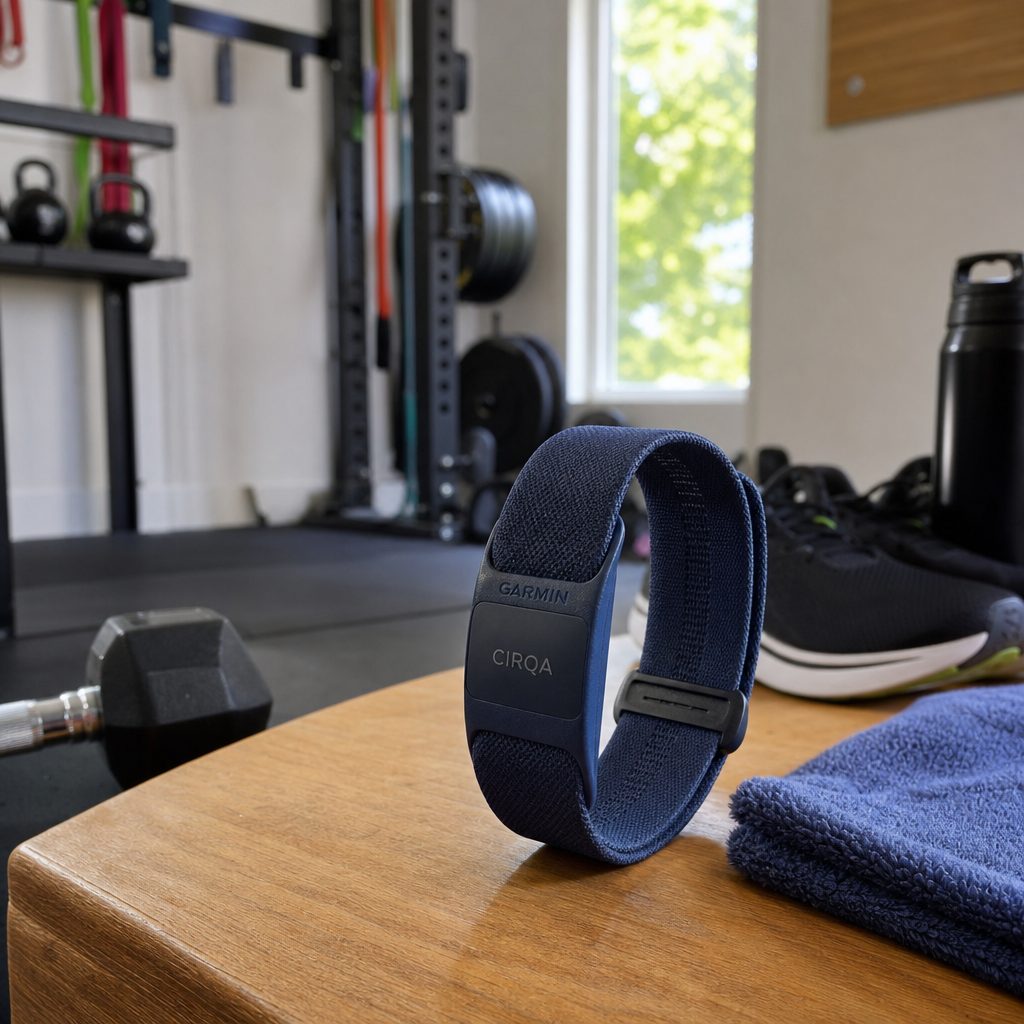
CIRQA made the most sense as a quiet long-term training companion: something you wear consistently, review thoughtfully, and do not have to charge or look at every day.
The weaker use case was the athlete who needs immediate feedback. If your programme depends on live pace, exact route data, elevation, navigation or swim heart-rate zones, CIRQA asks you to compromise too much. Garmin's broader range has products for that job. CIRQA's charm was that it did not pretend to be one of them.
12. Garmin CIRQA Smart Band FAQs
No. Garmin included CIRQA's core health, sleep and training metrics without a subscription. That was one of its major advantages over subscription-led screenless trackers. You bought the band and used Garmin Connect to review its data without an ongoing membership being required for the core experience.
CIRQA had no onboard GPS or GNSS. For outdoor activities, distance and pace came from connected GPS through a paired smartphone. It can therefore work for runners who are already happy carrying a phone, but it is not a phone-free outdoor sports tracker.
It was a good fit for strength training if you value overall session heart-rate and recovery context rather than live rep-by-rep metrics. In reported testing, CIRQA averaged 89.31bpm against 92.62bpm from a chest strap, a 3.3bpm difference. Upper-arm placement was reported as more accurate than wrist wear, so gym-focused buyers should seriously consider Garmin's optional biceps band.
Yes. CIRQA can be worn at the wrist or as an arm band, with the wear position set for each activity in Garmin Connect. Garmin sold optional upper-arm bands, and upper-arm placement was reported as more accurate for strength work than wrist placement.
Garmin rated CIRQA for up to 10 days of battery life. Actual endurance depended on usage, settings and wear patterns, but the claim placed it firmly in the low-maintenance category and made it well suited to continuous sleep and recovery tracking.
No. CIRQA has no screen, so it does not provide an on-wrist live heart-rate display or live pace field. You can start a favourite activity using its physical side button, and you can broadcast heart rate through ANT+ to compatible devices, but detailed review happens in Garmin Connect after the session.
CIRQA carried a 5 ATM water-resistance rating, so it was designed to handle water exposure. However, open-water testing published on 30 July 2026 found that it under-read heart rate by 20–30bpm compared with Polar Sense, WHOOP MG and Apple Watch Ultra 3. It is therefore not the best choice for swimmers who need dependable heart-rate-zone data.
CIRQA tracked continuous heart rate, HRV, sleep, stress, SpO2 and skin temperature. It also supported more than 80 activities, offered automatic detection for a variety of sessions, and stored the information for review and editing in Garmin Connect.
That depends on what you need during the session. CIRQA is better if you want a lightweight, screen-free band that is less intrusive around barbells, wrist wraps and sleep, with long battery life and no subscription. A smartwatch is better if you need live heart rate, pace, interval prompts, maps or other information visible while you train.
Verdict: Garmin CIRQA was a smartly focused first screenless band
Shop Garmin CIRQA was a smartly focused first screenless band on Amazon UK
The Garmin CIRQA Smart Band was a very good first attempt at a screen-free tracker from Garmin. Its biggest wins were obvious and meaningful: a soft, light design that was easy to wear day and night, a claimed battery life of up to 10 days, broad activity support, useful gym credentials, ANT+ heart-rate broadcasting and no subscription requirement for core metrics.
For strength training, indoor cycling, sleep tracking and general recovery awareness, it was a compelling alternative to a conventional smartwatch. The 89.31bpm versus 92.62bpm chest-strap strength result was encouraging, especially when paired with the evidence that upper-arm wear improved accuracy. The limitation was the older Elevate V4 sensor and its less convincing open-water performance, where CIRQA under-read by 20–30bpm in testing.
Buy CIRQA if you want Garmin's health and training ecosystem in a quiet, comfortable band and are happy to review data in the app afterwards. Skip it if you need onboard GPS, live workout fields, multisport support or highly dependable swim heart-rate tracking. It did not replace a full sports watch. It did something more modest, and for plenty of gym-goers, rather more appealing.