
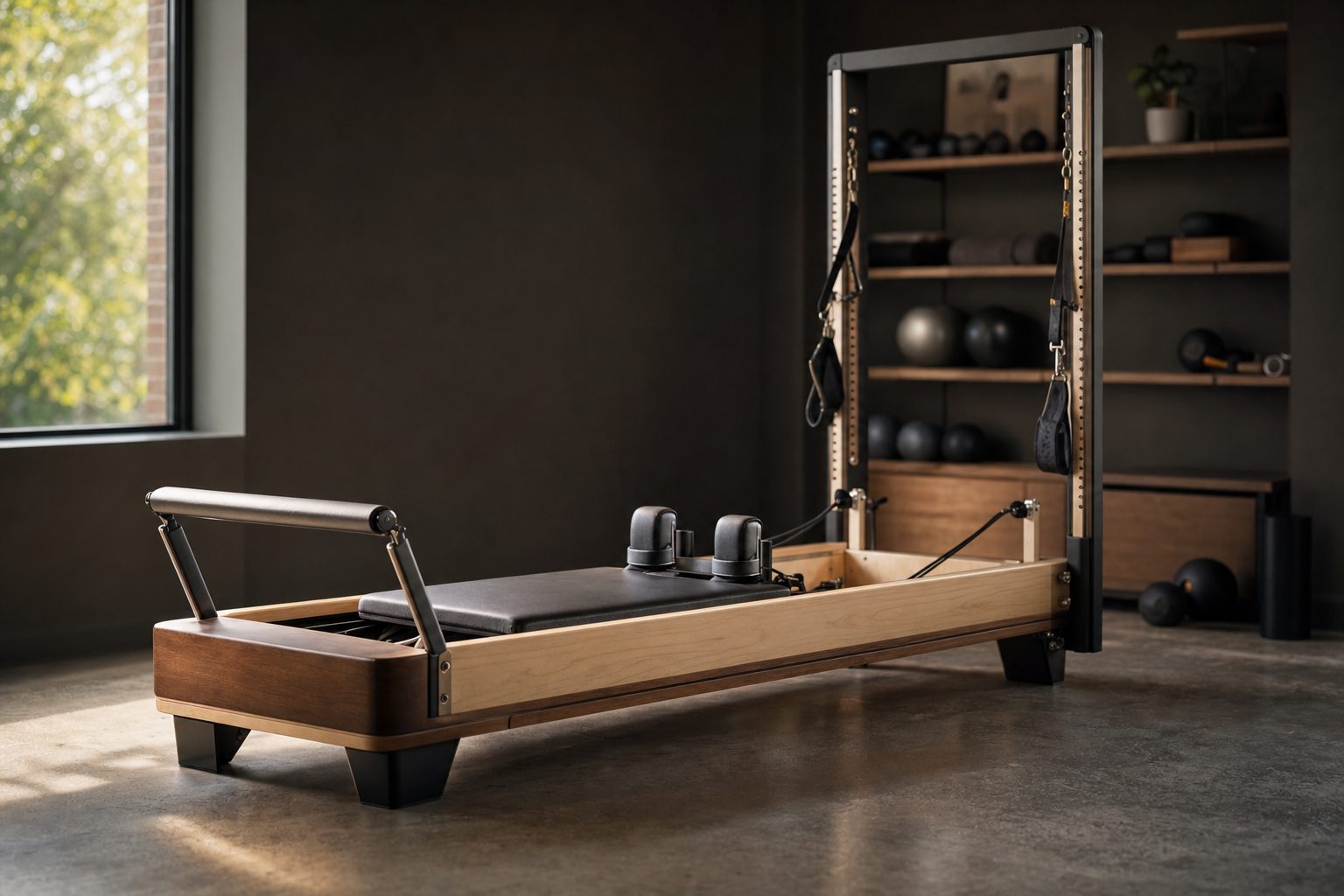
The NordicTrack Ultra 1 Reformer brings enclosed-spring, push-button Pilates to the home in maple and walnut finishes.
NordicTrack Ultra 1 Reformer Review: Is a £3,700 Connected Pilates Machine Worth It at Home?
Push-button resistance, a 24-inch swivelling touchscreen and iFIT coaching baked in — I've spent time getting to grips with NordicTrack's boldest home Pilates play to see whether the studio-to-living-room maths actually stacks up.
 By James Oduya · Staff Writer & Home Gym Columnist · Updated July 11, 2026
Reformer Pilates has quietly become one of the most in-demand fitness disciplines in the UK, and if you've tried to book a boutique class recently you'll know the drill: limited slots, eye-watering per-session prices and a waitlist that treats you like you're trying to get into a members' club. So when NordicTrack — a brand most people know for treadmills and bikes — decided to shrink the reformer down into something designed to actually live in a British home, my ears pricked up.
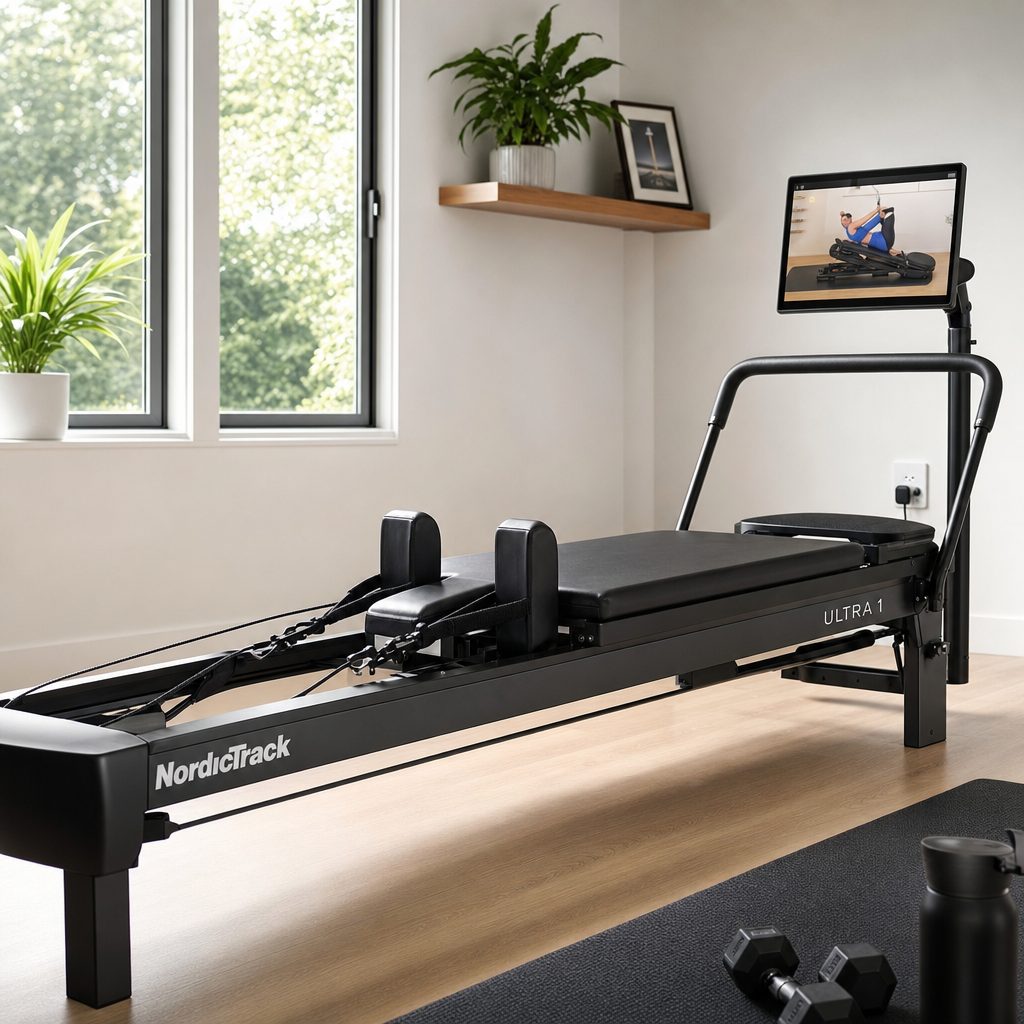
The Ultra 1 is the home-focused model; the beefier RX-S targets athletes with more resistance, a reinforced frame and a 28-position Infinity Footbar.
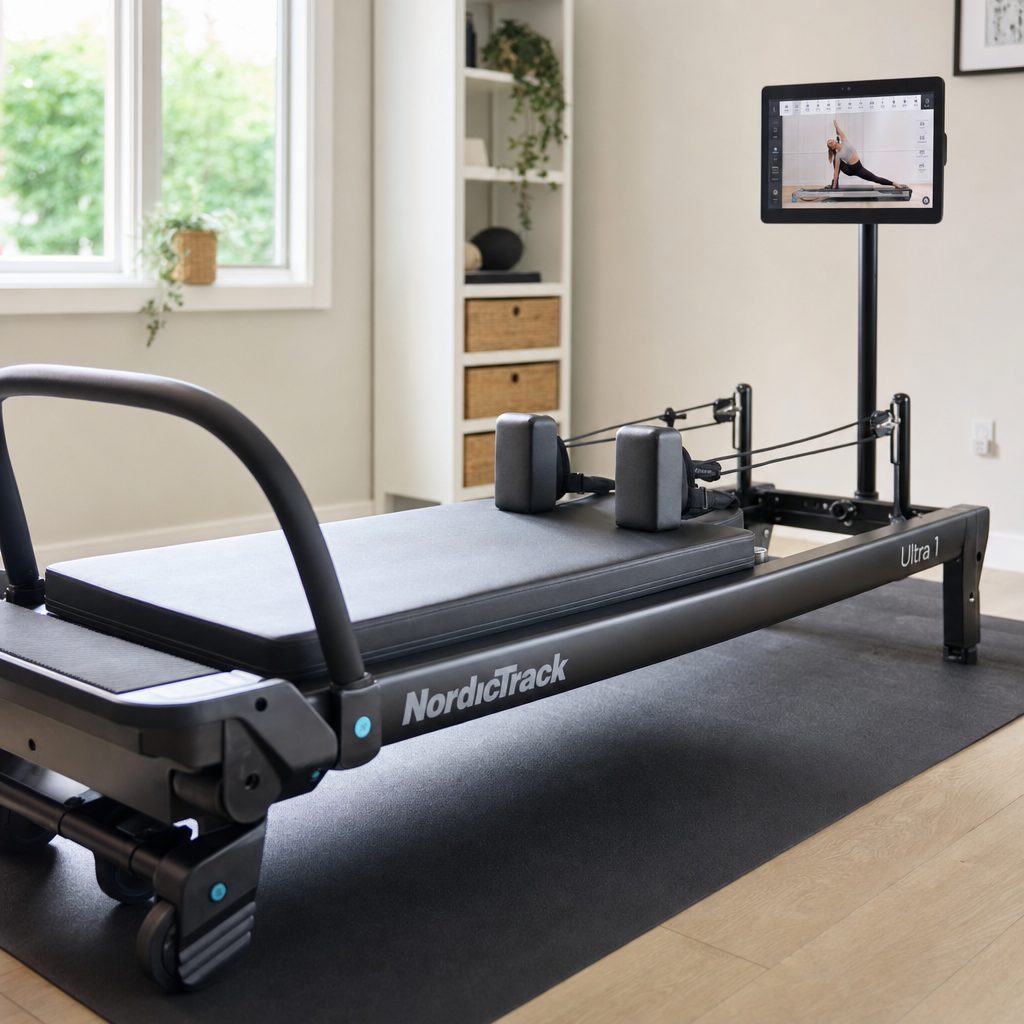
The Ultra 1 Reformer is the consumer model in NordicTrack's new Ultra Reformer Series, sitting below the burlier, studio-grade Ultra 1 Reform RX-S. It swaps the fiddly, exposed springs of a traditional reformer for an enclosed resistance system you control with three buttons, and it wraps the whole thing in wood panelling and a big tilting screen so it doesn't look like something the physio ordered. On paper it's the reformer for people who want the workout without the studio faff.
But there's the small matter of the price. This is a genuinely premium purchase, and it comes with an ongoing iFIT subscription if you want the full connected experience. So the real question isn't "is this a good reformer?" — it's "is this a good reformer for the money, in a home, versus simply paying a studio?" That's what I've set out to answer here. Let's get into it.
Ultra 1 Reformer: The Specs at a Glance
Shop Ultra 1 Reformer on Amazon UK
Before we get lost in the feel and the workouts, here's the hard hardware. The Ultra 1 is the home-focused model, and its numbers tell the story of a machine trying to bridge the gap between a proper reformer and something you'd genuinely tolerate in a spare room or living room corner.
The headline for me is that 24-inch display — bigger than the 21.5-inch panel on the pricier RX-S studio model — with a mount that tilts, pivots and swivels. That's a genuinely thoughtful touch, because reformer work sees you lying down, sitting up, kneeling and standing, and being able to physically turn the screen to face you in each position removes one of the most annoying frustrations of following along at home.
The resistance is handled entirely by three buttons rather than the coloured springs you'd hook and unhook on a classic reformer. There's a green button (10 kg), a blue button (15 kg) and a red button (20 kg), and combining them gives you seven distinct resistance levels in tidy 5 kg increments, from 10 kg all the way up to 45 kg. No more fumbling with metal clips mid-flow.
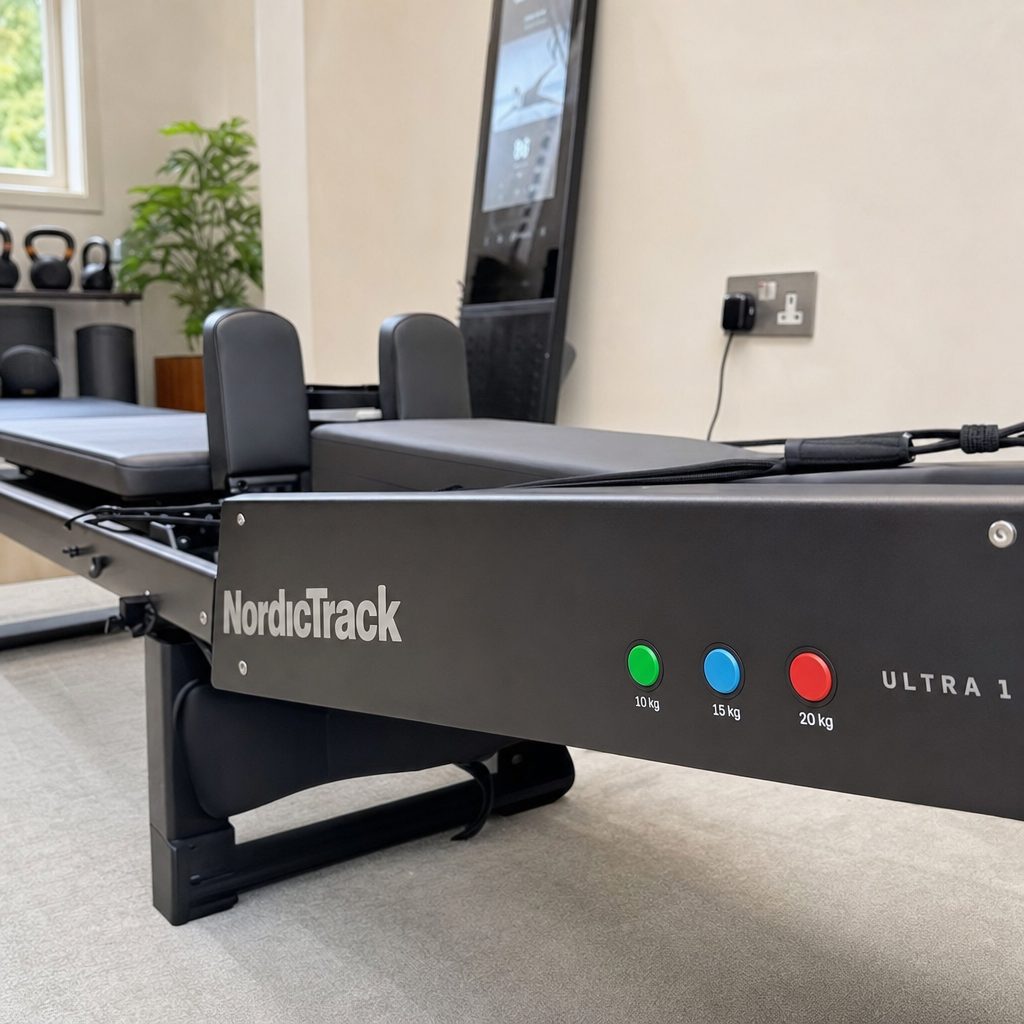
Three buttons — green (10 kg), blue (15 kg) and red (20 kg) — combine to deliver seven resistance levels from 10 kg to 45 kg.
Design and Build Quality
Let's address the thing everyone notices first: it doesn't look like gym kit. NordicTrack has clad the Ultra 1 in premium wood panelling, offered in a maple and a walnut finish, with integrated LED lighting running through the frame. In practice, this matters more than it sounds. A traditional reformer is an unapologetically clinical-looking object — all aluminium rails, exposed springs and upholstery — and most people simply don't want that dominating a room. The Ultra 1, by contrast, reads more like a considered piece of furniture. It's still a big object, but it's a handsome one.
The centrepiece of the build is the Smart Spine™ System, which encloses the springs entirely. Beyond the cleaner look, this is a real safety feature: there are no exposed springs to trap little fingers or curious pets, which NordicTrack rightly flags as a big deal for family homes. Anyone who's used an old-school reformer knows the pinch-hazard anxiety when springs are on show; here that's simply gone.
The carriage runs on stainless steel glide tracks, and the phrase NordicTrack keeps returning to is "virtually silent" — and honestly, that's fair. The glide is smooth and whisper-quiet, which is exactly what you want if you're training early in the morning or in a flat with people (or neighbours) nearby. There's none of the clunk-and-rattle you sometimes get on cheaper reformers.
Premium wood panelling
Available in maple and walnut finishes with integrated LED lighting, so it looks at home in a living space rather than a clinic.
Smart Spine™ enclosed springs
No exposed springs means a cleaner aesthetic and a genuinely safer machine around children and pets.
Twin cane-shaped footbars
Two footbars with four adjustable positions each, opening up a wide range of core and lower-body movements.
Stainless steel glide tracks
Deliver a smooth, near-silent carriage glide that's ideal for early mornings and shared living spaces.
The two cane-shaped footbars, each with four adjustable positions, give you real versatility across footwork, bridging, seated rowing and standing work. It's not the near-infinite adjustability of the RX-S (which offers up to 28 locking positions on its Infinity Footbar), but for a home user working through structured classes, four positions per bar is plenty and, crucially, easy to change without breaking your rhythm.
Pro Tip
At 89 kg and 236 cm long, this is not a machine you'll be shuffling around on a whim. Decide where it's going to live before delivery day, and measure carefully — NordicTrack recommends around 48 cm of clearance all the way around so you've got full range of movement for the standing and side-lying exercises.
Push-Button Resistance: The Standout Feature
If there's one thing that defines the Ultra 1's appeal, it's the push-button resistance — and having used it, I understand why NordicTrack leads with it. On a traditional reformer, changing resistance means physically attaching or detaching springs of different tensions, often mid-workout, which is fiddly, breaks your flow, and for beginners is a genuine source of confusion. Here you simply press one, two or three buttons.
The three buttons — 10 kg, 15 kg and 20 kg — combine to give you seven load settings: 10, 15, 20, 25, 30, 35 and 45 kg. That top end of 45 kg (99 lbs) is comfortably enough for the vast majority of home Pilates work. It won't match the RX-S's 143 lbs of resistance, which is aimed squarely at athletes doing high-frequency, high-load training, but for the standard reformer repertoire it's ample.
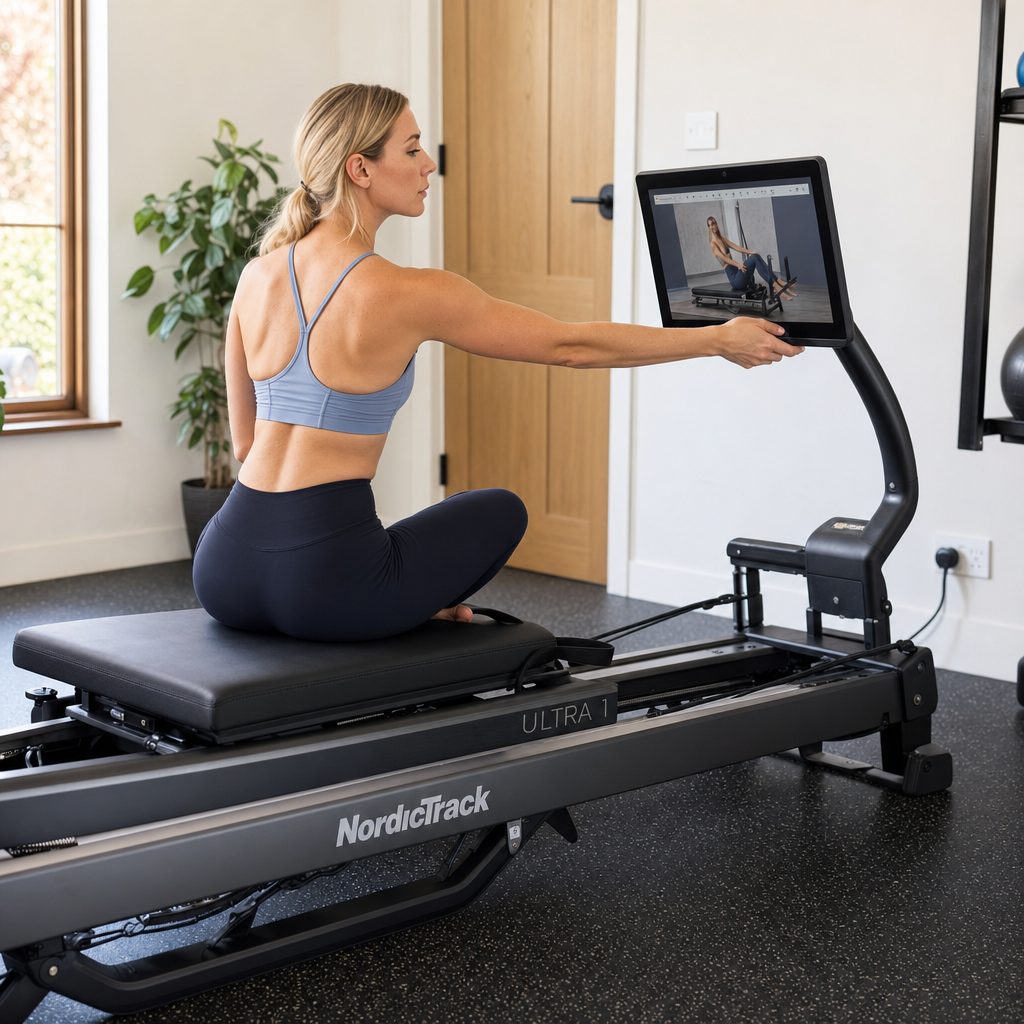
The 24-inch touchscreen tilts, pivots and swivels — a genuinely useful feature when your body position changes constantly during a reformer session.
What genuinely impressed me is what's happening behind those buttons. The Smart Spine™ system doesn't just apply resistance — it constantly measures spring tension to calculate your power output in real time, feeding biometric data straight to the screen. So rather than guessing whether you're working hard enough, you get live feedback on power and performance as you move. For anyone who likes to track progress (and let's be honest, if you're spending this kind of money, you probably do), that's a properly useful loop.
The 5 kg increments are worth thinking about. They're big, clean jumps — brilliant for beginners who want simplicity, but if you're used to the fine-grained tension tweaking of a classic multi-spring reformer, you may occasionally wish for something between two settings.
In use, the button system delivers exactly the benefit NordicTrack promises: it keeps you moving. During a guided class, when the instructor calls a resistance change, you tap a button and carry on, rather than sitting up, hunting for the right spring, and losing 15 seconds of momentum every time. Over a full session those saved moments add up, and the flow of the workout is dramatically better for it. This, more than the wood panelling or the big screen, is the thing that makes the Ultra 1 feel modern.
iFIT Integration and the Connected Experience
The Ultra 1 is powered by iFIT, and this is where the "connected" in connected Pilates machine really lives. Through iFIT you get access to a growing library of 75+ reformer-specific programs plus over 200 mat Pilates workouts — so even on days you don't fancy the full machine setup, there's a substantial catalogue of floor-based sessions to follow on that big swivelling screen.
That's a meaningful content library, and the reformer-specific programming is what justifies the machine over just following a YouTube mat class. The classes are built around the Ultra 1's exact hardware, so when an instructor calls for a resistance level, it maps to your buttons; when they cue a footbar position, it matches your machine. That tight coupling between content and kit is the whole point of a connected reformer, and NordicTrack has clearly built the two together rather than bolting an app onto generic hardware.
75+ reformer programs
Reformer-specific classes designed around the Ultra 1's exact resistance and footbar setup.
200+ mat Pilates workouts
A big library of floor-based sessions for days you want to train without the full machine.
Real-time biometric tracking
Smart Spine™ collects data and displays power output live on screen to help optimise results.
WiFi required
Connected coaching, tracking and the full iFIT catalogue all depend on a stable WiFi connection.
It's important to be straight about the subscription, though. The connected coaching, tracking and the whole iFIT content library require WiFi and an active iFIT membership. In the UK, iFIT is priced at £349 for an annual membership or £34 a month if you'd rather pay monthly. That's an ongoing cost on top of the machine, and you need to factor it into your decision — because without iFIT, you've got a very well-built reformer with a screen but far less of the guided experience that makes it special.
Pro Tip
If you're going to commit to the Ultra 1, take the annual iFIT plan rather than paying monthly. At £349 a year versus £34 a month (which works out at over £400 across twelve months), the annual option is the sensible move for anyone planning to actually use the machine regularly — which, for the money, you absolutely should be.
How It Performs Day to Day
Reformer work rewards consistency, and the day-to-day experience of the Ultra 1 is genuinely built around lowering the barrier to just doing the session. The near-silent glide means you can train without disturbing a sleeping household. The swivelling screen means you can transition between lying, seated and standing exercises without craning your neck. And the button resistance means the biggest source of mid-workout friction on a traditional reformer simply doesn't exist here.
The real-time feedback deserves another mention because it changes how you train alone. On a reformer in a studio, an instructor is watching your tempo and control. At home, you're on your own — but the Smart Spine™ constantly measuring spring tension and calculating power output gives you an objective sense of whether you're actually loading the movement properly, or just going through the motions. It's not the same as a live coach's eye on your form, but it's a smart substitute for effort and output tracking.
The 136 kg maximum user weight is a reasonable ceiling that covers most people comfortably, though it's worth noting it sits below the RX-S's 375 lb (roughly 170 kg) limit — a reminder that the RX-S is the tank of the range and the Ultra 1 is the elegant home companion. For the target audience — people who want to do quality reformer Pilates at home without turning their house into a studio — the Ultra 1's limits are sensible rather than restrictive.
One practical reality to keep front of mind: this is a large piece of equipment. At 236 cm long it needs a dedicated footprint, and while the swivelling screen lets you reorient it (its effective footprint shifts depending on whether the screen faces the front or swings to the side), you're not folding this away into a cupboard between sessions. It's a commitment to a space, and you should treat it as one.
Ultra 1 vs Ultra 1 Reform RX-S vs a Studio Membership
The most useful comparison isn't against another home reformer — it's understanding where the Ultra 1 sits between its own bigger sibling and the boutique studio experience it's designed to replace. Here's how the two NordicTrack models line up against the studio route.
| Feature | Ultra 1 Reformer | Ultra 1 Reform RX-S | Boutique Studio |
|---|---|---|---|
| Positioning | Home, design-led | Studio-grade / athletic | In-person classes |
| Display | 24" HD, tilt/pivot/swivel | 21.5" HD, 1920×1080 | None |
| Resistance | 10–45 kg, 7 levels, 3 buttons | Up to 143 lbs, 4 buttons | Spring-based |
| Footbar | Twin bars, 4 positions each | Infinity Footbar, 28 positions | Varies |
| Max user weight | 136 kg | 375 lbs (~170 kg) | n/a |
| Warranty | 2yr parts & labour | 5yr frame, 12mo components | n/a |
| Ongoing cost | iFIT £349/yr or £34/mo | iFIT £349/yr or £34/mo | Per-class or membership |
The RX-S is unquestionably the more serious machine — more resistance, a reinforced frame, a far more adjustable footbar and a longer frame warranty. But it's also built for a very different buyer: athletes and dedicated trainers pushing high-frequency, high-load sessions, and arguably light-commercial use. For most people setting up a home practice, the Ultra 1's extra screen inch, tidier footprint and design-led finish are the more relevant advantages, and 45 kg of resistance is genuinely enough.
Against a studio, the calculus is about lifestyle. High-end Pilates studio memberships can easily total £2,500–£5,500 (roughly $3,000–$7,000) per year once you're attending regularly. A home reformer is a large one-off outlay plus the iFIT subscription — but it's yours, it's available at 6am or 11pm, there's no travel, no booking scramble, and no per-class ceiling on how much you train. The trade-off is losing the in-person instructor correction and the community energy of a class, which for some people is precisely why they go to a studio in the first place.
Think honestly about why you'd go to a studio. If it's the workout and convenience, a home reformer wins comfortably over time. If it's the accountability, the atmosphere and having a coach physically adjust your form, no machine fully replaces that — and the biometric feedback here is a clever aid rather than a substitute for a real instructor's eye.
Pros and Cons
After weighing up the design, the resistance system, the connected experience and how it slots into daily life, here's the honest balance sheet.
Pros
- Push-button resistance keeps your workout flowing — no fumbling with springs mid-session
- Enclosed Smart Spine™ springs are safer around children and pets, and look far cleaner
- Large 24" tilt/pivot/swivel screen adapts to every body position
- Genuinely near-silent stainless steel glide tracks
- Real-time power-output feedback from the Smart Spine™ system
- Design-led wood panelling and LED lighting suit a living space
- 75+ reformer programs plus 200+ mat workouts via iFIT
Cons
- Full experience requires an ongoing iFIT subscription and WiFi
- 5 kg resistance increments are simple but coarse for advanced users
- Large 236 cm footprint — not something you can tuck away
- At 89 kg it's not easy to reposition once installed
- 2-year warranty is shorter than the RX-S's 5-year frame cover
- Less resistance and footbar adjustability than the RX-S
- No substitute for a live instructor's form corrections
The Value Question: Does the Maths Work?
This is the crux of the whole review, and it's worth being clear-eyed about it. A connected home reformer at this level is a significant investment, and the honest answer to "is it worth it?" depends almost entirely on how you'd otherwise be spending your Pilates money.
If you're currently paying for regular boutique reformer classes, the numbers move in the machine's favour surprisingly quickly. With studio memberships capable of running to several thousand pounds a year, a one-off machine purchase plus iFIT at £349 annually can pay for itself within a couple of years for a committed regular — and everything after that is effectively free training in perpetuity, available whenever you want it.
If, on the other hand, you're a casual once-a-fortnight attendee, or you're not certain the habit will stick, the maths is far less kind. A machine of this size and cost only makes sense if it's genuinely used, and there's a real risk of it becoming the world's most expensive clothes rail. Be brutally honest with yourself about your actual training frequency before committing.
Check the latest price and any current bundles on AmazonThe other factor is convenience value, which is hard to price but very real. Removing travel time, the booking scramble and class-time constraints genuinely changes how often people train. For busy parents, shift workers, or anyone who trains at unsociable hours, the ability to do a full reformer session at home whenever the window opens is worth a great deal — and it's exactly the kind of value that doesn't show up on a spreadsheet but shows up in how consistently you actually move.
Who Should Buy the NordicTrack Ultra 1 Reformer?
This isn't a machine for everyone, and that's fine — it's aimed at a specific kind of person quite deliberately. Here's who I think it genuinely suits.
The committed home trainer
If you already do reformer Pilates regularly and want to train on your own schedule without studio booking hassle, this is squarely built for you.
The studio member doing the maths
If your boutique membership is costing thousands a year, the machine plus iFIT can pay for itself over time and then keep giving.
The design-conscious buyer
If a clinical-looking reformer would never survive in your living space, the wood-panelled, enclosed-spring aesthetic solves that neatly.
The family household
The enclosed Smart Spine™ springs remove the pinch hazards of exposed springs, making it far more sensible around kids and pets.
Who should probably look elsewhere? Serious athletes wanting maximum load and near-infinite footbar adjustability should step up to the RX-S. Casual, infrequent users would likely be better served sticking with pay-as-you-go classes. And anyone tight on floor space simply needs to accept that a 236 cm reformer is a spatial commitment before anything else.
Frequently Asked Questions
Rating
For a committed home Pilates practice, the Ultra 1 makes a genuinely strong case — provided the space and the spend fit your life.
The Verdict
The NordicTrack Ultra 1 Reformer is the most convincing attempt I've seen to make a connected reformer that people actually want to live with. The push-button resistance is the star — it removes the single biggest friction point of home reformer work and keeps your sessions flowing exactly as a guided class should. Pair that with a big, thoughtfully mounted 24-inch screen, enclosed springs that are safer and cleaner, near-silent glide, and a genuinely deep iFIT library, and you've got a machine that delivers a serious home practice without turning your house into a clinic.
It isn't flawless. The full experience leans on an ongoing iFIT subscription, the 5 kg resistance jumps are coarse for advanced users, the footprint is large, and the 2-year warranty trails the RX-S's frame cover. But none of those are dealbreakers for its intended buyer.
The value question comes down to one thing: use it. If you're a committed reformer regular — especially one currently feeding a pricey studio membership — this pays back over time and rewards you with training freedom that's genuinely life-shaping in its convenience. If you're a casual dabbler, it's an expensive gamble on a habit that may not stick. Be honest about which you are, and if the answer is "committed," the Ultra 1 is a properly impressive piece of home fitness kit that earns its place.